Request a quote and our experts will contact you within 24 hours with tailored solutions and pricing.
By Ads for B2B SaaS Editorial Team. Last updated October 28, 2026.
B2B SaaS marketing through paid media means directing budget by cost per sales-qualified lead (SQL), not clicks: capture existing demand on Google Ads, then add LinkedIn Ads once the CRM feeds outcomes back to the platforms.
Most early-stage teams do the opposite. They raise spend, watch clicks climb, and see demos stay flat. In GrowthSpree's 2026 B2B SaaS Google Ads Waste Report (104 audited accounts, $78.0M spend, June 2026), accounts wasted an average of 34.0% of Google Ads spend, about $255K per account per year. That is an audit sample, not the whole market, but the pattern is clear. This guide maps which tactics move budget into pipeline at each stage, and it connects to the wider guide on PPC lead generation for B2B SaaS.
Key Takeaways
B2B SaaS paid media should be built in sequence: CRM tracking first, Google Ads search second, LinkedIn Ads third.
Default 7-day click attribution captured only 5% to 15% of revenue against an 84-day median sales cycle (GrowthSpree, 2026).
LinkedIn Ads showed 121% company-level ROAS against 67% for Google Search in Dreamdata's 2026 benchmark, which is vendor data (Dreamdata, 2026).
Click-through rate (CTR) correlated with pipeline at r = 0.09; cost per SQL correlated at r = 0.71 (GrowthSpree, 2026).
Channel tests judged on 30-day windows mislead when the average B2B journey runs 272 days (Dreamdata, 2026).
What paid media tactics drive pipeline for an early-stage B2B SaaS company?
The paid media tactics that drive pipeline for an early-stage B2B SaaS company run in order: connect the CRM to the ad platforms, capture demand with Google Ads search, add LinkedIn Ads for buying committees, and judge every ad on cost per SQL. The first step is the usual gap: 91% of audited accounts had no GCLID-to-CRM connection (GrowthSpree, 2026).
Brass pipe fittings joined in a sequence on a pale workbench, representing a staged paid media process
The four tactics in sequence
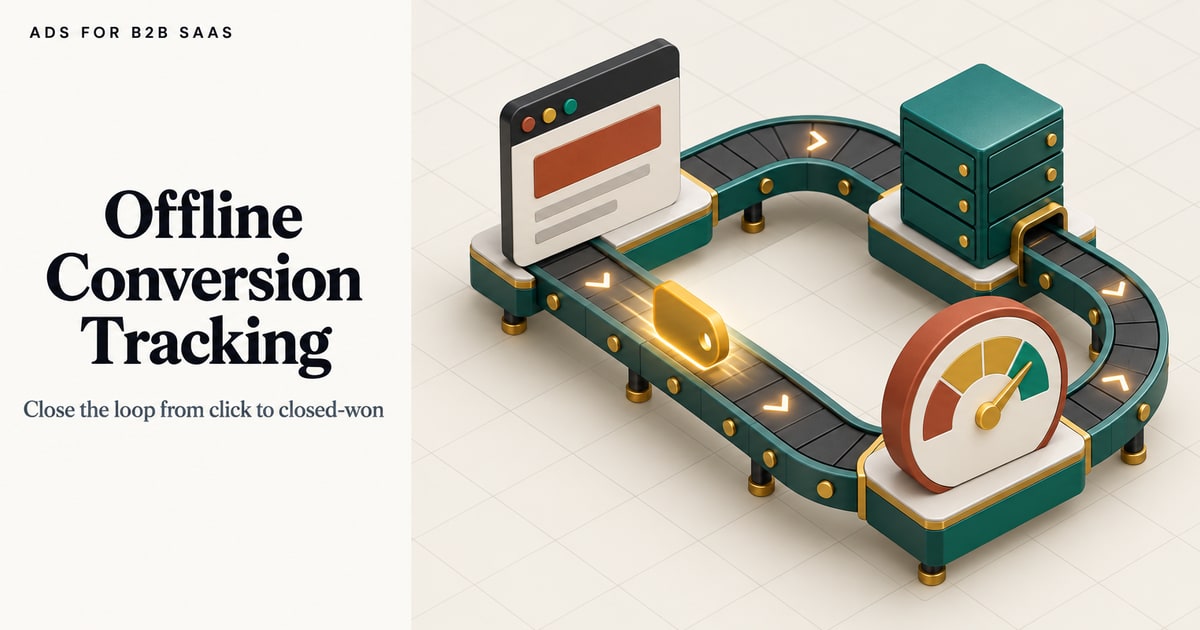
Connect the CRM to the ad platforms. Pass SQL and closed-won stages back as offline conversions so bidding learns from revenue, not form fills.
Start with Google Ads search. It captures buyers already looking for a solution.
Add LinkedIn Ads for reach into buying committees. B2B SaaS buying committees run 6 to 10 people (GrowthSpree, 2026).
Score every ad and campaign on cost per SQL. Ignore CTR and cost per lead (CPL) as ranking tools.
Tactic
Pipeline job
Evidence
CRM offline conversions
Tie clicks to SQLs and closed-won
91% of audited accounts had no GCLID-to-CRM connection (GrowthSpree, 2026)
Google Ads search
Capture existing demand
Non-brand lead cost $207 vs $34 for brand (PipeRocket, 2026)
r = 0.71 correlation with pipeline (GrowthSpree, 2026)
The table lists tactics in a build order, not a ranking of channels. A side-by-side channel verdict sits in the Google Ads vs LinkedIn Ads comparison.
Why should B2B SaaS teams fix attribution before raising ad spend?
Attribution should be fixed before spend rises because ad platforms optimise toward whatever conversion they receive. In GrowthSpree's 2026 B2B SaaS Google Ads Waste Report (104 accounts, June 2026), 91% of audited accounts had no Google click ID (GCLID) connection to the CRM, and 89% ran default attribution. Default 7-day click attribution captured only 5% to 15% of revenue against an 84-day median sales cycle.
A tangled bundle of network cables with one cable plugged cleanly into a labelled port
The Google click ID (GCLID) is the identifier Google appends to an ad click so a CRM can match that click to a later outcome. Offline conversions are CRM events, such as an SQL or a closed-won deal, uploaded back to an ad platform so its bidding can optimise toward them. Performance Max (PMax) is a Google Ads campaign type that automates bidding and placement across Google inventory.
What blind bidding costs
Automation spends faster on whatever signal it gets. In the same report, 78% of form fills never reached SQL status. PMax cost per SQL was $2,140 when running blind and $620 with offline conversions connected.
Sourced benchmark data: In GrowthSpree's 2026 B2B SaaS Google Ads Waste Report (104 accounts, $78.0M spend), a 90-day fix moved average waste from 34.0% to 11.0% and cut cost per SQL by 62%. Broad match without negative keywords and PMax without offline conversions together account for 56% of documented waste. Best-quartile accounts wasted 13.2%; worst-quartile accounts wasted 49.8%.
The window matters too. The average B2B customer journey lengthened from 211 to 272 days (Dreamdata, 2026). Dreamdata says "the nurturing phase has become the longest and most influential part of the customer journey" (Dreamdata, 2026). A 30-day window cannot see most of that.
A B2B SaaS company should start Google Ads when it has a defined ideal customer profile (ICP), a working offer, and a CRM that records which clicks become sales-qualified leads. Google Ads captures demand that already exists. In a 53-plus account dataset, non-brand search cost $207 per lead against $34 for brand search (PipeRocket, 2026).
A brass funnel catching droplets of water above a glass beaker on a white surface
An ideal customer profile (ICP) is the description of the company type, size and role most likely to buy and stay. A sales-qualified lead (SQL) is a lead that sales has accepted as a real opportunity. Both need definitions before spend starts, because Google needs a clear outcome to chase.
Capture, not create
Google Ads search works on intent. LinkedIn's B2B Institute, citing Dreamdata data, reported that branded search returned $12.99 per dollar while non-branded search returned $0.68, a loss of $0.32 per dollar (PPC Land, 2025). Non-brand campaigns are where a new B2B SaaS brand starts, so tracking has to be right before scaling them.
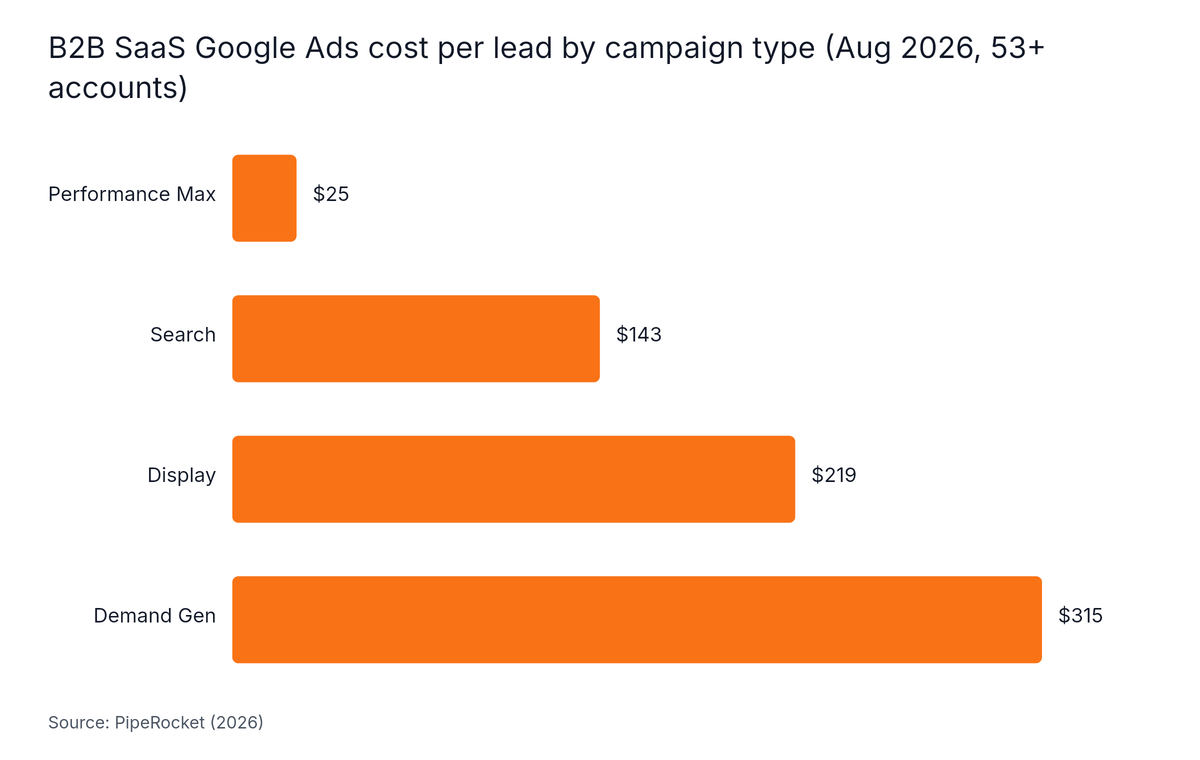
Cost per lead also differs sharply by campaign type, as the chart shows. PipeRocket's August 2026 data put Performance Max at $25 per lead and Search at $143 (PipeRocket, 2026).
Horizontal Bar chart: B2B SaaS Google Ads cost per lead by campaign type (Aug 2026, 53+ accounts). Highest: Demand Gen at $315.
A low CPL is not a good result by itself. PMax's $25 lead cost carries no pipeline outcome in that dataset.
A worked example of cost per SQL
Cost per SQL equals cost per lead divided by the share of leads that become SQLs. The numbers here are hypothetical, chosen to show the arithmetic. Suppose a lead costs $100 and 20% of leads become SQLs. Cost per SQL is $100 divided by 0.20, or $500. If the SQL rate falls to 10%, the same lead price gives $1,000 per SQL.
For context, the median B2B SaaS cost per SQL is $800 to $2,500 (GrowthSpree, April 2026).
Benchmark
Value
Source and sample
Median B2B SaaS non-brand CPC
$8.50 to $14.00
GrowthSpree, April 2026
Median B2B SaaS cost per SQL
$800 to $2,500
GrowthSpree, April 2026
DevTools CPC and cost per SQL
$7.50 and $650
GrowthSpree, April 2026
Cybersecurity CPC and cost per SQL
$18.00 and $3,500
GrowthSpree, April 2026
Benchmarks differ by source and definition, so rebuild the target from your own account once SQL data flows. More on the channel is in the guide to paid search for B2B SaaS.
When does LinkedIn Ads become worth the higher cost per click?
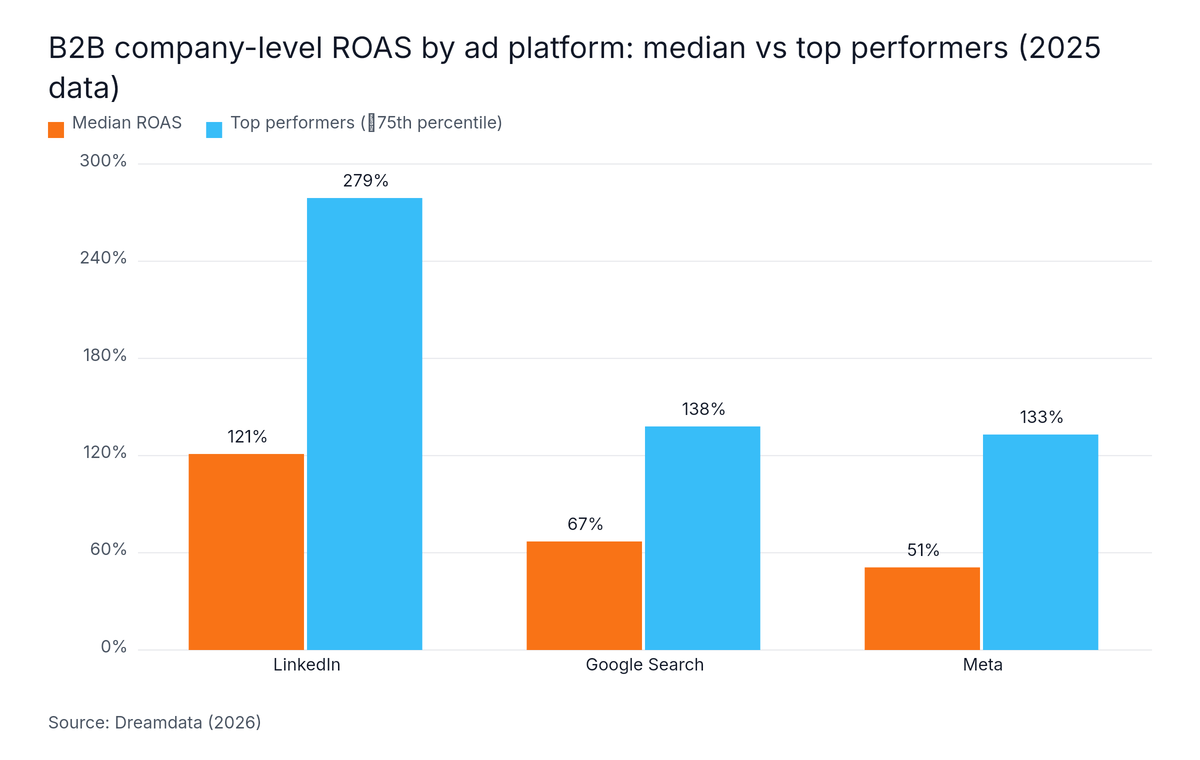
LinkedIn Ads becomes worth its higher cost per click when Google Ads search is already tracked to SQLs and the team needs to reach buying committees by job title. In Dreamdata's 2026 benchmark, LinkedIn was the only major platform with positive company-level return on ad spend (ROAS) at 121%, against 67% for Google Search (Dreamdata, 2026).
A magnifying glass over a printed ledger page focusing on a single highlighted row of figures
Return on ad spend (ROAS) is the revenue attributed to ads divided by the ad spend. Dreamdata sells attribution software, so this is vendor data, built on data-driven attribution over closed-won deals across 12 months. Meta came in at 51% in the same benchmark (Dreamdata, 2026).
Why cost per contact misleads
On a contact basis LinkedIn is far pricier per click than Meta: €5.98 against €1.60 (Dreamdata, 2026). The company-level view reverses that picture. As Dreamdata puts it: "But in B2B, we close companies, not contacts." (Dreamdata, 2026). Among top performers, LinkedIn ROAS rose to 279% against 138% for Google Search (Dreamdata, 2026).
Grouped Bar chart: B2B company-level ROAS by ad platform: median vs top performers (2025 data). Highest: LinkedIn at 121%.
The chart repeats the headline: median company-level ROAS of 121% for LinkedIn, 67% for Google Search and 51% for Meta (Dreamdata, 2026).
What LinkedIn costs and where it leaks
LinkedIn CPC for B2B SaaS runs $8 to $25 by vertical. Cost per SQL runs $800 to $8,000 by annual contract value (ACV) tier (GrowthSpree, Wasted LinkedIn Ads Spend in B2B SaaS, June 2026). Across 56 audited accounts and $9.4M spend, average waste was 32.0%, about $53,600 per account. Job function, seniority and company size targeting accounted for 67% of that waste. Decision-makers received only 33% of budget against a 60%-plus target.
A fair LinkedIn test needs three things before it starts:
Google search outcomes tracked to SQLs.
A tight ICP list, with decision-makers getting most of the budget.
A review window long enough to match the sales cycle, not 30 days.
Why do CTR and CPL predict so little about B2B SaaS pipeline?
Click-through rate (CTR) and cost per lead (CPL) predict little about pipeline because they are measured before a lead is qualified. In The Paid Ads Pipeline Disconnect (GrowthSpree, 1,412 ad variants, 96 accounts, $14.2M spend, June 2026), CTR correlated with pipeline at r = 0.09 and CPL at r = 0.23, while cost per SQL reached r = 0.71.
Two balance scales side by side, one holding pebbles and the other a single gold coin, level
Metric
Correlation with pipeline (r)
What it measures
CTR
0.09
Clicks per impression
CPL
0.23
Platform cost per form fill
Cost per SQL
0.71
Cost per sales-accepted lead
In 43% of A/B tests, the higher-CTR winner produced fewer or costlier SQLs. Re-scoring ads by cost per SQL improved cost per SQL by about 44% with no extra spend. Pausing low-CTR ads and scaling high-CTR ones can therefore remove the ads that bring pipeline.
Buyers also spend roughly the first 220 days forming decisions through content and self-education before entering the sales pipeline (Dreamdata, 2026). A click metric cannot see that. See creative best practices for what drives pipeline in ad copy and offers.
How do paid media tactics change from Series A to growth stage?
Paid media tactics change by stage mainly in how many channels run and how long each gets to mature. Early teams run one search channel tied to the CRM; later teams add LinkedIn Ads and retargeting. Dreamdata customers put 41% of B2B paid budgets into LinkedIn in 2026, up from 39% in 2024 (PPC Land, 2026).
The framework below is an editorial sequence, not a sourced set of thresholds. It reflects the evidence cited above.
Stage
Main job
Tactics
Measure
Seed to early Series A
Prove one channel
CRM tracking, non-brand search, tight negatives
Cost per SQL
Series A
Add reach
LinkedIn Ads to ICP decision-makers, offline conversions on both platforms
Cost per SQL by channel, long window
Series B
Scale what pays
Reallocate by cost per SQL, retargeting, creative testing
Pipeline per dollar
Growth
Widen the mix
Further channels such as Reddit, YouTube and programmatic, tested on the same rules
Closed-won revenue per channel
Budget context matters. Paid media reached a five-year high of 31.4% of marketing expenses in Gartner's 2026 CMO Spend Survey (Chief Marketer, 2026). That sample of 401 CMOs skews to companies above $1B revenue, so treat it as directional for a Series A team. Related reading: ad channels and budget allocation and what ROAS means for B2B SaaS.
Who is this B2B SaaS paid media sequence not for?
B2B SaaS paid media sequenced as CRM tracking, then Google Ads, then LinkedIn Ads is not for teams that cannot yet record lead outcomes in a CRM, sell only through product-led self-serve, or want a ranked channel verdict. The benchmarks come from audit and vendor samples, such as 104 Google Ads accounts and 56 LinkedIn accounts (GrowthSpree, 2026), so they describe patterns, not guarantees.
Stated limits worth knowing:
Audit samples. The GrowthSpree studies draw on audited accounts, which are a convenience sample. Waste rates for accounts that were never audited may differ.
Vendor data. Dreamdata sells attribution software, and its ROAS figures use data-driven attribution on its own customers.
Mixed definitions. CPC and CPL benchmarks differ by source, currency (Dreamdata reports in euros) and definition. Use ranges, not single targets.
No stage thresholds. The stage table is a sequence, not a spend rule. Budget depends on ACV and sales cycle.
Frequently Asked Questions
How much do B2B SaaS companies waste on Google Ads?
The 2026 B2B SaaS Google Ads Waste Report (GrowthSpree, 104 accounts, $78.0M spend) found an average waste rate of 34.0%, or roughly $255K per account per year. The best quartile wasted 13.2% and the worst quartile 49.8%. Broad match without negative keywords and Performance Max without offline conversions together account for 56% of documented waste.
What is a good CPC for B2B SaaS Google Ads?
The SaaS Google Ads Benchmarks 2026 report (GrowthSpree, April 2026) puts the median B2B SaaS non-brand cost per click at $8.50 to $14.00. DevTools sits at the low end at $7.50 and Cybersecurity at the high end at $18.00. CPCs vary with vertical, match type and campaign structure.
Should B2B SaaS use Performance Max?
Performance Max without offline conversions is one of the two largest drivers of Google Ads waste in B2B SaaS, according to the 2026 B2B SaaS Google Ads Waste Report (GrowthSpree, 104 accounts). Accounts running it blind saw a cost per SQL of $2,140, against $620 for accounts with offline conversions connected.
What attribution window should B2B SaaS use for Google Ads?
A window matched to the sales cycle. The default 7-day click window captures only 5% to 15% of revenue against an 84-day median sales cycle (GrowthSpree, 2026). Capture the Google click ID in the CRM, import SQL and closed-won stages as offline conversions, and report on a longer window.
Conclusion
B2B SaaS paid media pays back when each step earns the next one. Five points to carry forward:
Connect the CRM first: 91% of audited accounts had no GCLID-to-CRM link (GrowthSpree, 2026).
Start with Google Ads search, and read non-brand and brand results separately.
Add LinkedIn Ads when search is tracked to SQLs and the ICP is tight.
Rank ads on cost per SQL (r = 0.71), not CTR (r = 0.09).
Judge channels on a window that fits a 272-day journey, not 30 days.
The best next step is an audit of the account's conversion setup, starting with what Google and LinkedIn are told counts as a win. Bring the account questions to a paid media expert and brainstorm the fix: Meet with an expert. Free consultation. Bring your ad account questions and brainstorm with a paid media expert.
Written by
Ishan Manchanda
Ishan Manchanda is co-founder of GrowthSpree, a B2B SaaS marketing consultancy founded in 2017 that has managed $60M+ in ad spend across 300+ B2B SaaS companies. He focuses on demand generation, go-to-market strategy and pipeline growth, and has been featured in Silicon Valley Times, SaaS Mag and the Unbounce podcast.
 Ishan ManchandaNov 9, 2026