Blog
Offline Conversion Tracking for B2B SaaS: How It Works and Why the Default Setup Fails
Offline conversion tracking sends CRM pipeline back to ad platforms. Learn how the GCLID loop closes, what to set up first, and why 7-day attribution fails.
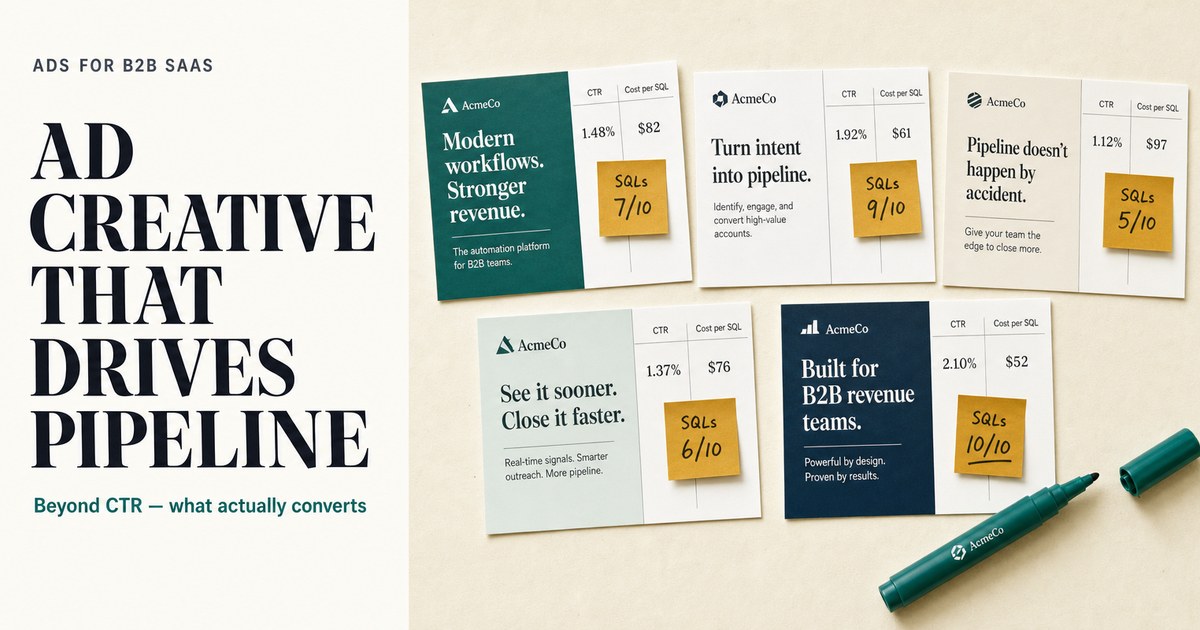
CTR correlated with pipeline at r=0.09 across 1,412 ad variants. This guide covers copy, format and testing decisions that lower cost per SQL instead.
Offline conversion tracking sends CRM pipeline back to ad platforms. Learn how the GCLID loop closes, what to set up first, and why 7-day attribution fails.
Learn how to reduce wasted ad spend in B2B SaaS: causes, a waste rate formula, quartile benchmarks and a prioritised fix list that keeps total budget.

Why ad platform conversions and CRM pipeline never match in B2B SaaS: attribution windows, form fills that miss SQL, a GCLID audit and a fix sequence.
Request a quote and our experts will contact you within 24 hours with tailored solutions and pricing.
adsforb2bsaas.com
Last updated: Oct 22, 2026
B2B SaaS ad creative best practices are the copy, format and testing decisions that lower cost per sales-qualified lead (SQL) rather than cost per click: across 1,412 ad variants and $14.2M in spend, cost per SQL correlated with pipeline at r=0.71 while click-through rate (CTR) correlated at only r=0.09 (The Paid Ads Pipeline Disconnect, GrowthSpree, PD26, June 2026).
The problem most B2B SaaS paid media teams face is invisible. CTR goes up, cost per lead (CPL) ticks down, the dashboard looks good, and the quarter still falls short on pipeline. In 43% of A/B tests from that same dataset, the higher-CTR ad produced fewer or costlier SQLs. CTR-based winner selection actively harms pipeline efficiency, and most platforms reward it by default.
This guide covers what the data actually supports: which copy decisions filter for SQL-quality buyers, which formats reach the right committee members, how to structure tests that declare winners on revenue-relevant signals, and how to manage creative fatigue in the small audiences B2B SaaS campaigns target.
Key Takeaways
- CTR correlated with pipeline at r=0.09 across 1,412 B2B SaaS ad variants; cost per SQL correlated at r=0.71 (The Paid Ads Pipeline Disconnect, GrowthSpree, PD26, June 2026).
- In 43% of A/B tests, the higher-CTR ad produced fewer or costlier SQLs. CTR-based winner selection actively harms pipeline efficiency.
- B2B SaaS buying committees involve 6 to 10 decision-makers, each gathering 4 to 5 independent research pieces before group deliberation (Gartner B2B Buying Survey, 2024). Creative must be mapped to roles, not broadcast to an undifferentiated audience.
- Rescoring ad variants by cost per SQL instead of CTR improved cost per SQL by approximately 44% with no additional spend (The Paid Ads Pipeline Disconnect, GrowthSpree, PD26, June 2026).
- Creative fatigue arrives faster in narrow B2B SaaS audiences: a Meta-internal study found a 45% CTR drop after the fourth repetition of the same ad (Meta, via adlibrary.com, 2026).
Click-through rate (CTR) is the percentage of ad impressions that result in a click, and a poor creative success metric for B2B SaaS. Across 1,412 ad variants and $14.2M in spend, CTR correlated with pipeline at r=0.09, close to zero, while cost per SQL correlated at r=0.71 (The Paid Ads Pipeline Disconnect, GrowthSpree, PD26, June 2026). Cost per lead (CPL) is total ad spend divided by leads generated at the platform level - and it correlated at only r=0.23, also weak. In 43% of A/B tests, the higher-CTR ad produced fewer or costlier sales-qualified leads (SQLs).
The Paid Ads Pipeline Disconnect (GrowthSpree, PD26, June 2026) - 1,412 ad variants, 96 accounts, $14.2M in spend: CTR correlated with pipeline at r=0.09. CPL correlated at r=0.23. Cost per SQL correlated at r=0.71. In 43% of A/B tests, the higher-CTR winner produced fewer or costlier SQLs. Rescoring ad variants by cost per SQL instead of CTR improved cost per SQL by approximately 44% with no additional spend.

The r=0.09 finding is not a marginal difference. An r-value near zero means knowing one ad has a higher CTR tells you almost nothing about whether it will produce more pipeline. Yet CTR remains the default optimisation signal in most paid media dashboards, and most A/B test frameworks declare winners on it automatically.
CPL looks slightly better at r=0.23, but it still counts every form fill - including the 78% that never reach SQL status (The 2026 B2B SaaS Google Ads Waste Report, GrowthSpree, G26, June 2026). An ad pulling cheap, unqualified clicks always looks efficient on CTR and CPL. It looks expensive on cost per SQL.
The practical implication is a different leaderboard. When the PD26 dataset was rescored by cost per SQL rather than CTR, cost per SQL improved by approximately 44% with no extra spend (GrowthSpree, PD26, June 2026). The budget did not change. The creative mix did. Ads paused for low CTR turned out to be the cheapest SQL generators; ads scaled for high CTR turned out to be the most expensive.
Switching the declared winner from CTR to cost per SQL requires connecting ad spend data to CRM pipeline data. That measurement foundation is covered in the testing section below.
B2B SaaS ad creative must reach a buying committee of 6 to 10 decision-makers, each conducting 4 to 5 pieces of independent research before group deliberation (Gartner B2B Buying Survey, 2024). Forrester's 2024 State of Business Buying Report found the average B2B purchase involves 13 internal stakeholders and 89% of buying decisions cross multiple departments (Forrester, via tractioncomplete.com, 2024). Creative mapped to a single generic audience cannot move a committee with this structure.

"Gartner reports that 99% of B2B purchases are driven by organizational change, which means the problem being solved usually spans departments" (Callbox, citing Gartner, 2025). That span is the creative challenge: different stakeholders worry about different things, and a headline written for the economic buyer will not resonate with the technical evaluator or the end user.
The roles worth separating in B2B SaaS creative targeting are:
Each role sees a different ad. Each ad names that role's exact problem. Running one generalised creative to all three roles produces a message relevant to none of them.
Buying committee composition also varies by vertical. In Cybersecurity, security and compliance leads carry significant veto power. In HR Tech, the People team often initiates the purchase but finance signs off. In DevTools, the technical evaluator frequently leads the evaluation. Creative that ignores vertical-specific committee structure will underperform against campaigns built around it.
B2B buyers spend 27% of their total purchase time researching independently online, and 75% prefer a rep-free buying experience (Gartner B2B Buying Survey, 2024). "Buyers spend just 17% of their time considering and engaging with potential suppliers" (Sopro, 2025). The ad, the landing page and supporting content must complete the persuasion that a sales call used to handle. Pre-sales creative is what places a B2B SaaS product on the buyer's shortlist.
When evaluating multiple vendors, a single sales rep receives just 5 to 6% of buyer time (Gartner B2B Buying Survey, 2024). Committee members who never book a demo still vote on the shortlist. The ad may be the only contact a vendor gets with them.
"Creative quality and landing page alignment directly impact whether paid social leads convert to SQL" (Flighted, 2026). Message-match between the ad and the landing page is a SQL-rate driver, not just a conversion-rate driver. An ad that makes a specific promise must land on a page that fulfils it, not on a generic homepage. The click is wasted when the landing page breaks the promise the ad made.
Ad copy for B2B SaaS lowers cost per SQL when it names the role, the problem and a measurable outcome in the first line, rather than leading with a product category or feature. Headline specificity filters out browsers and draws in the in-market buyer. "Creative quality and landing page alignment directly impact whether paid social leads convert to SQL" (Flighted, 2026). Copy that reaches the right person at the right stage costs more per click but far less per SQL.
| Copy element | What it does | Example |
|---|---|---|
| Role signal in headline | Filters the audience before the click | "For VP Marketing: why your CPL is lying to you" |
| Named problem | Attracts buyers with the live pain | "Spend is up. Demos are flat." |
| Measurable outcome | Sets expectation before the landing page | "Cut cost per SQL without adding budget" |
| Specificity over category | Avoids generic ad blindness | "84-day sales cycle? Your attribution window is wrong." |
The copy decisions that inflate CTR while degrading SQL quality:
The alternative is specificity at every element: role in the headline, problem in the description, measurable outcome in the CTA. A CTA that names the next concrete step self-selects the audience. A generic one does not.
Thought Leader Ads (TLAs) are a LinkedIn Ads format that amplifies posts from individual employee profiles as sponsored content, reaching a median CTR of approximately 0.7% in 2026-the highest among LinkedIn formats - compared to 0.62% for Document Ads, 0.55% for Carousel, 0.5% for Single Image and 0.44% for Video (Silverback Marketing, 2026). Format CTR is a weak pipeline proxy; Document Ads and Thought Leader Ads tend to draw engaged, role-specific readers rather than broad casual traffic.
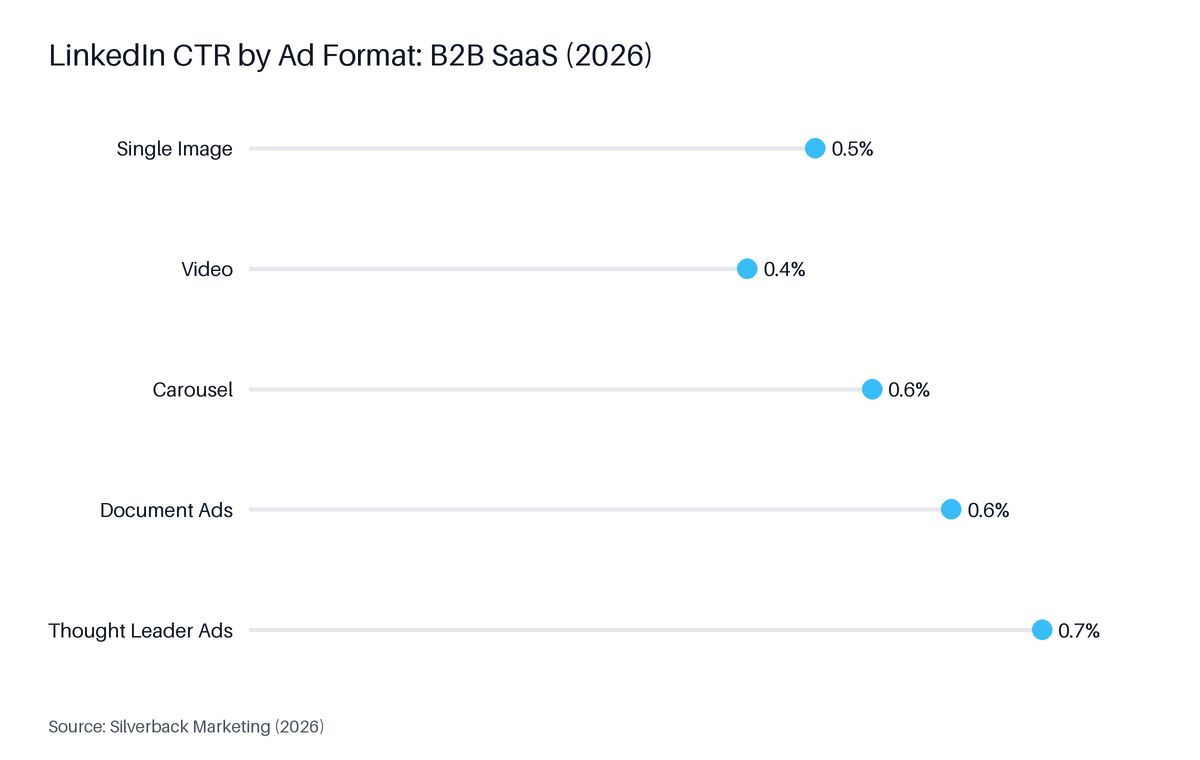
Source: Silverback Marketing, 2026
The table below summarises LinkedIn formats against the signals most relevant to B2B SaaS pipeline:
| Format | Median CTR (Silverback Marketing, 2026) | Audience pull | Pipeline signal | Best use case |
|---|---|---|---|---|
| Thought Leader Ads | ~0.70% | High intent, personal credibility | Strong | Shortlist reinforcement, top-of-funnel trust |
| Document Ads | ~0.62% | Role-specific, high engagement | Strong | Committee research phase, gated content |
| Carousel | ~0.55% | Multi-message, moderate intent | Moderate | Multi-stakeholder narrative, feature comparison |
| Single Image | ~0.50% | Broad reach, variable intent | Moderate | Brand awareness, retargeting |
| Video | ~0.44% | Passive consumption | Weaker | Awareness; harder to attribute to SQL |
Thought Leader Ads derive their higher CTR partly from personal credibility: a post amplified from a named employee's profile carries social proof that a brand logo alone cannot. HockeyStack's 2025 LinkedIn Ads Benchmark Report, covering 70+ B2B SaaS companies and $28M in spend, found Q3 delivers the best pipeline return on LinkedIn at 6.01x for every $1 spent (HockeyStack, 2025), though timing alone does not determine format effectiveness.
Different formats serve different committee roles at different stages:
A/B tests for B2B SaaS ad creative should declare winners on cost per SQL, not CTR. In 43% of tests, the higher-CTR ad costs more per SQL (GrowthSpree, PD26, June 2026). Rescoring ad variants by cost per SQL improved that metric by approximately 44% with no extra spend. The 2026 B2B SaaS Google Ads Waste Report (GrowthSpree, G26, June 2026) found 91% of audited accounts had no Google click ID (GCLID)-to-CRM connection - making SQL-level creative scoring impossible without fixing measurement first.
The Paid Ads Pipeline Disconnect (GrowthSpree, PD26, June 2026) - 96 accounts, $14.2M in spend: Rescoring and reallocating budget by cost per SQL rather than CTR improved cost per SQL by approximately 44% with no additional spend. The higher-CTR ad produced fewer or costlier SQLs in 43% of tests.
"We test creative, copy, audiences, and formats systematically - not because it's best practice, but because it's how you stop guessing and start knowing" (Refine Labs, 2025).
Connect ad spend to CRM pipeline before testing. Without a GCLID-to-CRM connection or LinkedIn's Conversions API feeding SQL and closed-won data back to the platform, scoring creative on SQL outcomes is not possible. Fix measurement before running creative experiments.
Isolate one variable per test. Testing headline and image simultaneously produces uninterpretable results. Isolate headline copy first - role signal vs. problem signal vs. outcome signal - then image, then CTA, then format.
Set a minimum SQL threshold before declaring a winner. CTR winners can be declared with a few hundred impressions. SQL winners require enough pipeline events to be meaningful. A minimum of 10 to 15 attributed SQLs per variant is a practical starting floor, adjusted for actual sales cycle length.
Rescore the creative library by cost per SQL on a rolling basis. Scale variants with the lowest cost per SQL. Pause variants with the highest, regardless of CTR. Repeat monthly.
| Test variable | Variant A | Variant B | Winner metric |
|---|---|---|---|
| Headline | Role signal ("For VP Marketing") | Problem signal ("Spend up. Demos flat.") | Cost per SQL |
| Image | Abstract data visual | Flat-lay of printed report | SQL velocity (days to first SQL) |
| CTA | "Book a demo" | "See the benchmark" | SQL rate from click |
| Format | Single Image | Document Ad | Cost per SQL |
Creative fatigue is the measurable decline in ad performance caused by repeated exposure to the same creative in a small audience. A Meta-internal study found a 45% CTR drop after the fourth repetition of the same ad, compressing effective creative lifespan to 2 to 3 weeks on high-frequency placements (Meta, cited via adlibrary.com, 2026). For LinkedIn campaigns targeting a narrow ideal customer profile (ICP), frequency accumulates within days, not months.

The narrow-audience problem is structural in B2B SaaS. A campaign targeting VP Marketing at Series B SaaS companies in North America might reach 15,000 to 30,000 accounts. Running three ad variants into that audience on a modest daily budget will hit the four-impression threshold in weeks, not months.
The creative framework in this guide is built for B2B SaaS advertisers with a median sales cycle of 84 days and buying committees of 6 to 10 people (The 2026 B2B SaaS Google Ads Waste Report, GrowthSpree, G26, June 2026). Advertisers in B2C, direct-to-consumer or ecommerce will find the SQL-first approach does not map to their buying dynamics. At low annual contract value (ACV) tiers, LinkedIn cost per SQL can reach $800 to $8,000 by ACV tier (Wasted LinkedIn Ads Spend in B2B SaaS, GrowthSpree, L26, June 2026) - and those economics may not justify the approach regardless of creative quality.
Return on ad spend (ROAS) is revenue generated divided by ad spend, and it suits ecommerce and short-cycle B2B rather than an 84-day median sales cycle where individual transactions are too slow and too infrequent for ROAS to be a reliable creative signal. At low-ACV deals, the cost per SQL benchmarks in this guide - median $800 to $2,500 for B2B SaaS Google Ads (SaaS Google Ads Benchmarks 2026, GrowthSpree, B26, April 2026) - may be difficult to sustain. When the economics do not support a cost per SQL in that range, the channel or the ACV tier is the constraint, not the creative.
Click-through rate (CTR) does not reliably predict pipeline for B2B SaaS. The Paid Ads Pipeline Disconnect study (GrowthSpree, 1,412 ad variants, 96 accounts, $14.2M spend, June 2026) found CTR correlated with pipeline at r=0.09-close to zero - while cost per sales-qualified lead (SQL) correlated at r=0.71. In 43% of A/B tests, the higher-CTR ad produced fewer or costlier SQLs.
Cost per lead (CPL) correlated with pipeline at only r=0.23 across 1,412 ad variants (GrowthSpree, PD26, June 2026). CPL is measured at the platform and includes all form fills, of which 78% never reach sales-qualified lead (SQL) status (GrowthSpree, G26, June 2026). Optimising creative on CPL directs budget toward volume over quality - the wrong trade-off when the median B2B SaaS sales cycle runs 84 days.
B2B SaaS buying committees typically have 6 to 10 decision-makers, each gathering 4 to 5 independent research pieces before group deliberation (Gartner B2B Buying Survey, 2024). Map audience segments to the roles that matter most - economic buyer, technical evaluator, end user - and run separate creative for each, naming the role's specific problem and a measurable outcome rather than broadcasting a generic message.
A Meta-internal study found a 45% CTR drop after the fourth repetition of the same ad, compressing effective creative lifespan to 2 to 3 weeks on high-frequency placements (Meta, cited via adlibrary.com, 2026). For narrow LinkedIn audiences typical of B2B SaaS, frequency accumulates faster. Rotate in at least one new variant every two to three weeks and monitor frequency at campaign level to prevent premature creative decay.
There is no universal impression threshold for B2B SaaS creative tests. Because SQL events take weeks to register against an 84-day median sales cycle (GrowthSpree, G26, June 2026), a minimum of 10 to 15 attributed SQLs per variant is a practical starting floor before declaring a winner. Declaring on CTR alone will select the wrong ad in 43% of tests (GrowthSpree, PD26, June 2026).
Document Ads on LinkedIn achieved a median CTR of approximately 0.62% in 2026 versus 0.44% for Video (Silverback Marketing, 2026). Document Ads draw role-specific, high-engagement readers - the committee members actively researching solutions - while Video drives passive awareness. For pipeline quality in B2B SaaS, Document Ads tend to support better sales-qualified lead (SQL) rates. Test both against cost per SQL, not CTR.
Neither CTR nor form-fill conversion rate reliably predicts pipeline in B2B SaaS. CTR correlated with pipeline at r=0.09 and cost per lead (CPL) at r=0.23 across 1,412 ad variants (GrowthSpree, PD26, June 2026), while 78% of form fills never reach SQL status (GrowthSpree, G26, June 2026). The correct optimisation signal is cost per SQL, which requires CRM-to-platform measurement to be in place first.
The gap between a high-CTR creative and a high-pipeline creative is not a design problem. It is a measurement problem. Across 1,412 ad variants and $14.2M in spend, CTR predicted pipeline at r=0.09 while cost per SQL predicted it at r=0.71 (GrowthSpree, PD26, June 2026). Rescoring creative by cost per SQL improved that metric by approximately 44% with the same budget.
The practical sequence: connect CRM pipeline data to ad platforms first, so SQL outcomes are measurable at the creative level. Reframe copy around roles and specific problems rather than features and categories. Match formats to buying stages rather than defaulting to the highest-CTR option. Declare A/B test winners on SQL velocity, not CTR. Rotate creative before frequency causes decay in the narrow ideal customer profile (ICP) audience every B2B SaaS campaign targets.
The median B2B SaaS cost per SQL runs from $800 to $2,500 depending on vertical (SaaS Google Ads Benchmarks 2026, GrowthSpree, B26, April 2026). The creative decisions in this guide shift that number without increasing spend.
Meet with an expert. Free consultation. Bring your ad account questions and brainstorm with a paid media expert at Ads for B2B SaaS.
© 2026 adsforb2bsaas.com All rights reserved.

