Blog
Offline Conversion Tracking for B2B SaaS: How It Works and Why the Default Setup Fails
Offline conversion tracking sends CRM pipeline back to ad platforms. Learn how the GCLID loop closes, what to set up first, and why 7-day attribution fails.
Why ad platform conversions and CRM pipeline never match in B2B SaaS: attribution windows, form fills that miss SQL, a GCLID audit and a fix sequence.
 Ishan ManchandaNov 5, 2026

Offline conversion tracking sends CRM pipeline back to ad platforms. Learn how the GCLID loop closes, what to set up first, and why 7-day attribution fails.
Learn how to reduce wasted ad spend in B2B SaaS: causes, a waste rate formula, quartile benchmarks and a prioritised fix list that keeps total budget.
Match your CRM, ad platform and sales cycle to the right offline conversion tracking method for Google Ads, Microsoft Ads, Meta and Salesforce.
Request a quote and our experts will contact you within 24 hours with tailored solutions and pricing.
Last updated: Nov 5, 2026
A data discrepancy between ad platforms and the CRM is the gap between the conversions an ad platform counts and the pipeline a B2B SaaS CRM records, caused by different events, attribution windows, identity matching and lead-qualification rules.
Google says 200 conversions. Sales says 12 real leads. Both can be right, because each system measures a different event on a different clock. In The 2026 B2B SaaS Google Ads Waste Report (GrowthSpree, 104 accounts and $78.0M in spend, June 2026), 91% of audited accounts had no Google click ID (GCLID) connection to the CRM, so the platform never learned which clicks became pipeline. This guide explains each cause, shows how to audit the gap, and sets out a fix that spans ad platform settings and CRM configuration. For the wider spend picture, see the guide to diagnosing wasted ad spend.
Key Takeaways
- A data discrepancy between ad platforms and the CRM is expected in B2B SaaS, because the platform counts form fills while the CRM counts sales-qualified leads (SQLs) and closed-won deals.
- Default 7-day click attribution captured only 5% to 15% of revenue against an 84-day median sales cycle in audited B2B SaaS accounts (GrowthSpree, June 2026).
- 91% of audited B2B SaaS accounts had no GCLID-to-CRM connection, so bidding automation never saw which clicks turned into pipeline (GrowthSpree, June 2026).
- Closing the gap needs ad platform changes and CRM changes together: GCLID capture, offline conversions, enhanced conversions for leads and one agreed SQL definition.
- A 90-day fix moved average Google Ads waste from 34.0% to 11.0% and cut cost per SQL by 62% (GrowthSpree, June 2026).
By Ads for B2B SaaS Editorial Team. Last updated: October 28, 2026. A human editor signs off on every draft, and sources are chosen under the site's Methodology page.
A data discrepancy between ad platforms and the CRM comes from five mismatches: the two systems count different events, use different time windows, identify people differently, date conversions differently and gate leads by qualification. In B2B SaaS, a median 84-day sales cycle (Optifai, 2026) magnifies each mismatch, because the click and the closed deal sit months apart.

The Optifai figure comes from a pipeline study of 939 B2B SaaS companies. It is a vendor dataset and has not been independently replicated, so treat it as a benchmark, not a law.
The table maps each cause to what each system counts and where the fix lives.
| Cause | What the ad platform counts | What the CRM records | Where the fix lives |
|---|---|---|---|
| Event definition | Every tracked form fill | Only leads that pass filtering and qualification | CRM stage definitions, offline conversions |
| Time window | Conversions inside a short click window | Deals that close months later | Attribution settings, offline import |
| Identity | A browser or click ID | A person, account and buying committee | GCLID field, enhanced conversions for leads |
| Date logic | Date of the click or of the conversion | Date the lead or deal was created or closed | Reporting rules, cohort views |
| Qualification gating | A conversion at submission | An MQL, then SQL, then opportunity | Shared SQL definition, stage sync |
In The 2026 B2B SaaS Google Ads Waste Report (GrowthSpree, June 2026), 91% of audited accounts had no GCLID-to-CRM connection and 89% ran default attribution before the audit. Without a click ID in the CRM, nobody can tell the platform which click produced which deal. Marketing then reports form fills from the platform, sales reports pipeline from the CRM, and the two teams argue over lead quality with no shared number.
The problem is rarely a bug. It is a design gap. The platform was configured for a short-cycle, single-buyer purchase, and the CRM was configured for sales stages. Nothing connects them unless someone builds the bridge.
Default attribution windows miss B2B SaaS revenue because they close weeks before deals do. In The 2026 B2B SaaS Google Ads Waste Report (GrowthSpree, 104 accounts and $78.0M in spend, June 2026), default 7-day click attribution captured only 5% to 15% of revenue against an 84-day median sales cycle.
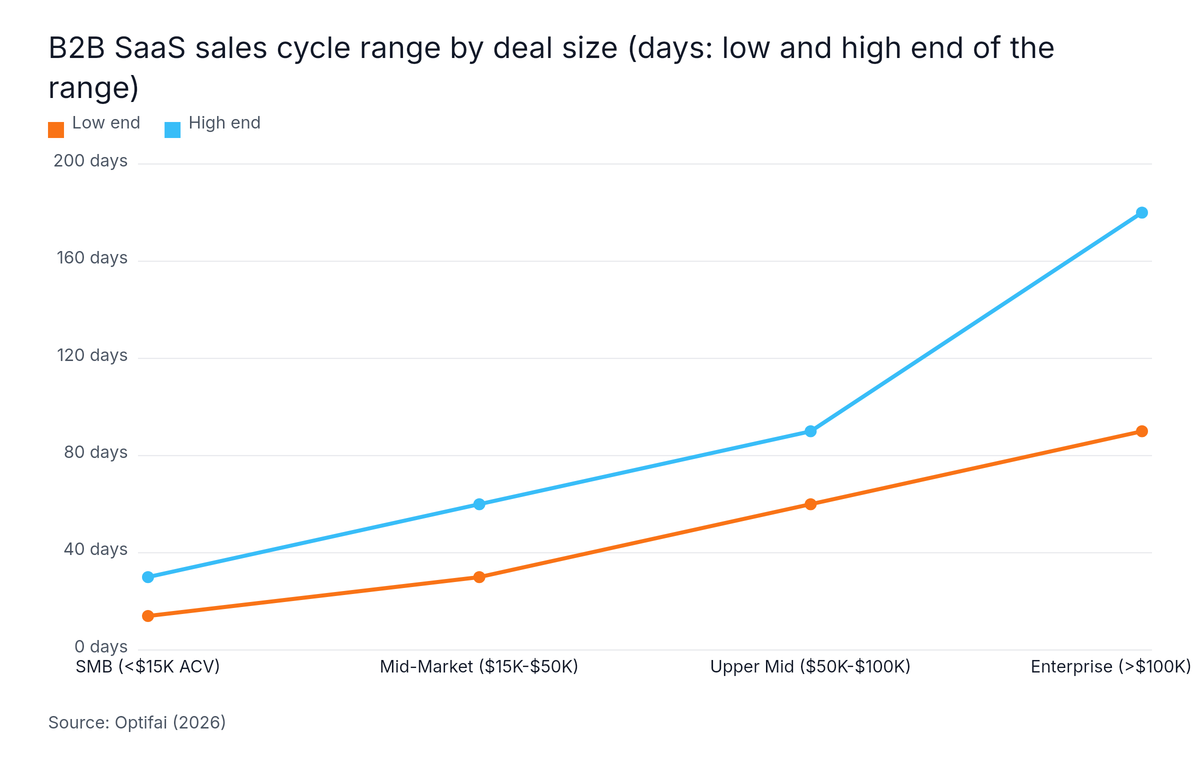
Source: Optifai, 2026
Attribution window is the number of days after a click during which a platform credits a conversion to that click. A click that converts on day 80 falls outside it, so the platform records nothing, while the CRM later books the revenue. As of mid-2026, Google Ads documentation describes a default click window of 30 days; confirm the current setting in your own account, since defaults and per-action settings can differ.
Sales cycles also stretch with deal size. Annual contract value (ACV) is the yearly revenue a customer contract is worth. In the Optifai dataset (Optifai, 2026), the plotted cycle figures run from 14 days for SMB deals under $15K ACV to 30 days for mid-market, 60 days for upper mid-market and 90 days for enterprise deals above $100K ACV. Longer cycles mean more revenue lands after the window closes. Paid search sits at the front of that journey, as the guide to paid search for B2B SaaS explains.
Sourced benchmark data: Across 104 audited B2B SaaS accounts and $78.0M in spend (GrowthSpree, The 2026 B2B SaaS Google Ads Waste Report, June 2026), 89% ran default attribution before the audit.
The gap is simple subtraction. A window that ends before the median deal closes leaves every later event invisible to the platform.
| Window or journey length | Comparison point | Days left outside the window |
|---|---|---|
| 7-day click window | 84-day median sales cycle | 77 days |
| 30-day click window | 84-day median sales cycle | 54 days |
| 30-day click window | 272-day full journey | 242 days |
The 272-day figure comes from Dreamdata (2026), whose telemetry shows the full B2B journey, from first tracked touch to close, now runs 272 days, up from 211. The same report finds buyers spend roughly the first 220 days forming purchase decisions before entering the sales pipeline. In the words of the report, "B2B deals are essentially won before sales get involved in the process" (Dreamdata, 2026). Dreamdata's data reflects its own customer base, not a random market sample.
The CRM sees opportunity stages, owners and revenue, but only the part of the buyer journey after sales opens a deal, while the ad platform sees clicks and form fills. Dreamdata's 2026 benchmarks report found 81% of the B2B customer journey now happens outside the sales pipeline, up from 70% the year before (Dreamdata, 2026).

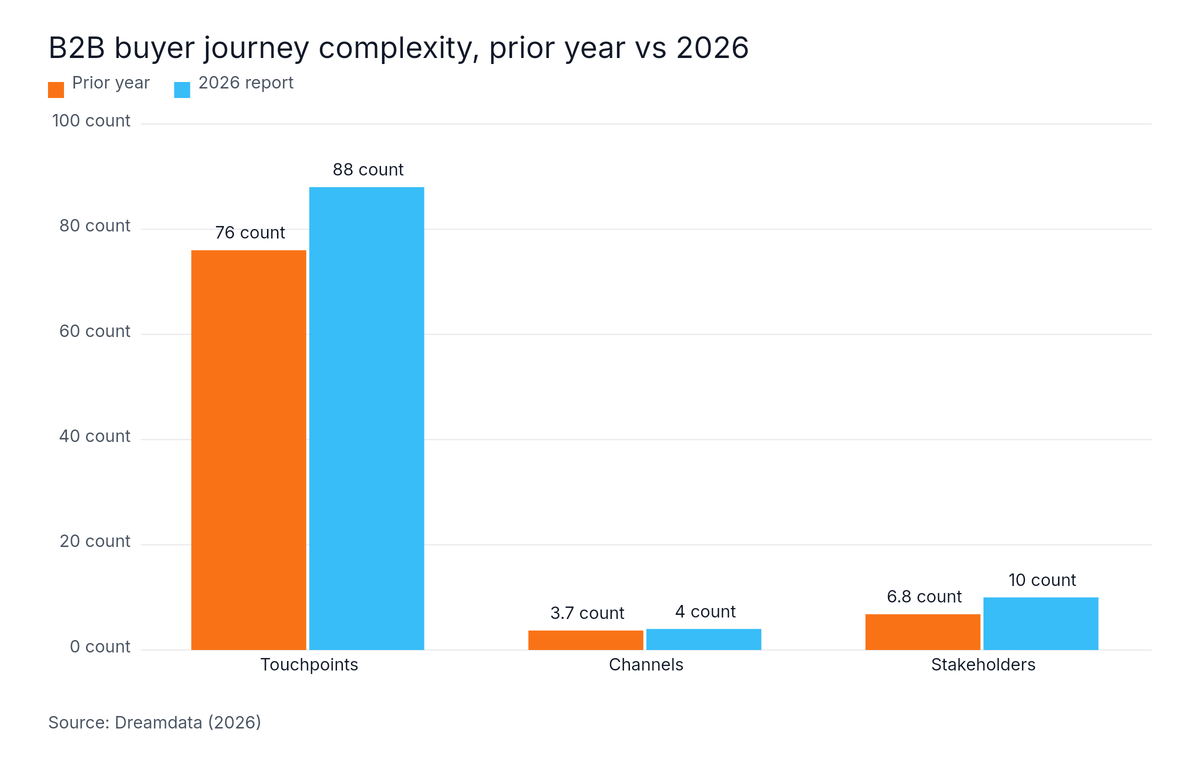
Neither system holds the full path. The CRM opportunity record starts late, and the ad platform stops early. A single conversion also hides many people. The same report (Dreamdata, 2026) puts the typical B2B buyer journey at 88 touchpoints, up from 76, across 4 channels and 10 stakeholders, up from 6.8. The 2026 B2B SaaS Google Ads Waste Report (GrowthSpree, June 2026) similarly puts B2B SaaS buying committees at 6 to 10 people.
Source: Dreamdata, 2026
The chart shows the prior-year baselines (76 touchpoints, 3.7 channels and 6.8 stakeholders) beside the 2026 figures of 88 touchpoints, 4 channels and 10 stakeholders. In practice, one click ID can represent only one person's visit. The deal may involve nine other people who never clicked the ad that the platform credits.
This is why identity matching matters. When the person who clicked is not the person who signs, a click ID alone cannot connect the two. Account-level matching in the CRM and first-party data fill part of that gap, as the fix sequence below covers.
Form fills fail to become sales-qualified leads because sales disqualifies some submissions, some qualified submitters never book a meeting, and some fills were never buyers, yet the ad platform still counts each fill as a conversion. In The 2026 B2B SaaS Google Ads Waste Report (GrowthSpree, June 2026), 78% of form fills never reached SQL status.

Sales-qualified lead (SQL) is a lead that sales has vetted and accepted as a genuine sales opportunity. Marketing-qualified lead (MQL) is a lead that marketing has scored as likely to buy, before sales has reviewed it. The platform's conversion tag fires at submission, long before either label applies.
Chili Piper (2025) found 14.1% of demo form submissions were disqualified, 561,977 in total, across nearly 4 million submissions from mostly B2B SaaS customers in 2024. The platform counts those as conversions, but they never reach sales as qualified leads. Only 66.7% of qualified submissions then booked a meeting (Chili Piper, 2025), a figure that applies when instant scheduling is offered. Both are vendor customer datasets, not market averages.
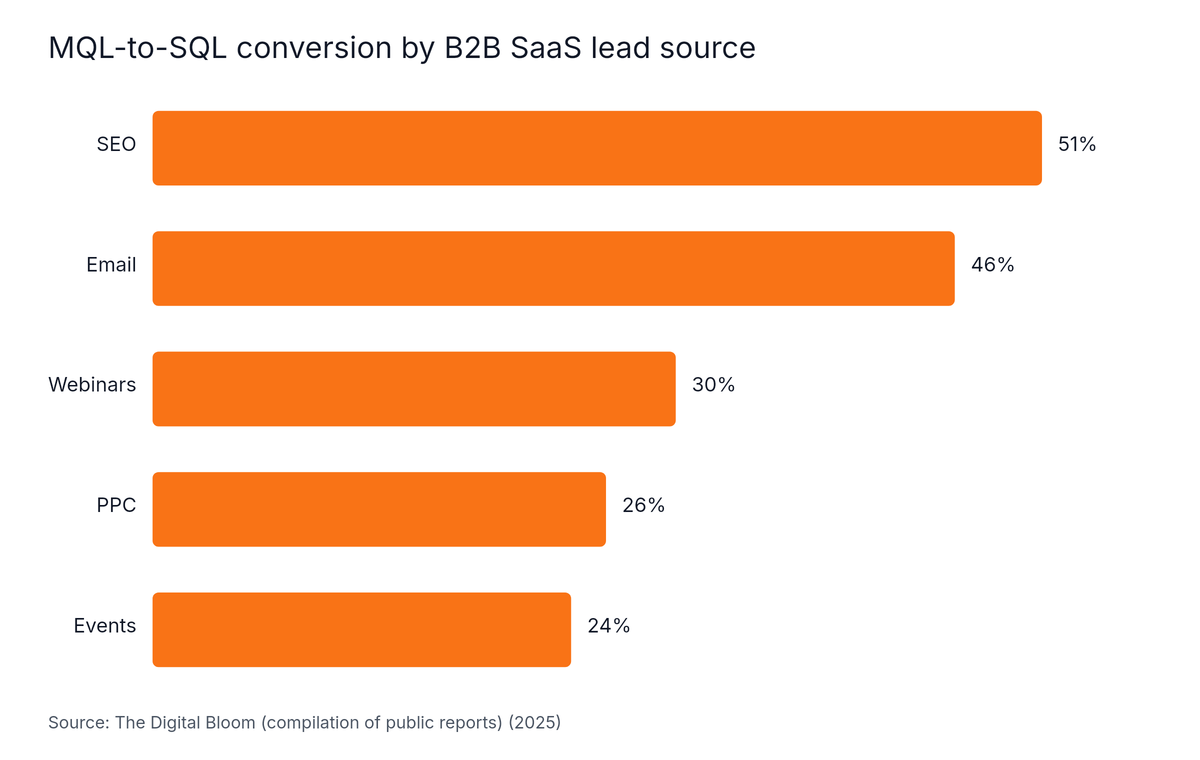
Lead source matters too. The Digital Bloom (2025), compiling public B2B SaaS reports, puts the MQL-to-SQL rate for PPC-sourced leads at 26%, versus 51% for SEO leads. That is a secondary compilation, so verify the upstream study before using it in a board deck.
Source: The Digital Bloom (compilation of public reports), 2025
The chart plots MQL-to-SQL conversion by lead source, with PPC at 26% and SEO at 51% (The Digital Bloom, 2025). Paid leads reach SQL status less often than the platform's conversion count implies.
| Stage | Who defines it | Evidence on drop-off |
|---|---|---|
| Platform conversion (form fill) | The ad platform's tag | Counts every submission, including the 14.1% later disqualified (Chili Piper, 2025) |
| Qualified form submission | Sales or marketing ops | 66.7% of qualified submissions book a meeting (Chili Piper, 2025) |
| MQL to SQL | Sales | 26% for PPC-sourced leads (The Digital Bloom, 2025) |
| Form fill to SQL | Sales | 78% of form fills never reach SQL (GrowthSpree, June 2026) |
| Closed-won | CRM | Months after the click in B2B SaaS |
Definitions of SQL vary widely between companies, so agree one before reconciling counts.
The data discrepancy changes budget decisions because bidding automation optimizes toward whatever conversion it is fed, and form fills are a weak proxy for pipeline. In The 2026 B2B SaaS Google Ads Waste Report (GrowthSpree, June 2026), Performance Max (PMax) campaigns ran at $2,140 cost per SQL without offline conversions and $620 with them.

Performance Max (PMax) is a Google Ads campaign type that automates bidding and placement across Google channels using the conversion signals it receives. Cost per SQL is ad spend divided by the number of sales-qualified leads produced. Feed PMax form fills, and it finds more form fills.
The metrics teams watch also predict pipeline poorly. The Paid Ads Pipeline Disconnect study (GrowthSpree, 1,412 ad variants, 96 accounts, $14.2M in spend, June 2026) measured how each metric tracks pipeline.
| Metric | Correlation with pipeline (r) | What it implies |
|---|---|---|
| Click-through rate (CTR) | 0.09 | Close to no relationship |
| Cost per lead (CPL) | 0.23 | Weak relationship |
| Cost per SQL | 0.71 | Strong relationship |
In 43% of A/B tests in that study, the higher-CTR winner produced fewer or costlier SQLs. Re-scoring ads by cost per SQL improved cost per SQL by about 44% with no extra spend (GrowthSpree, June 2026).
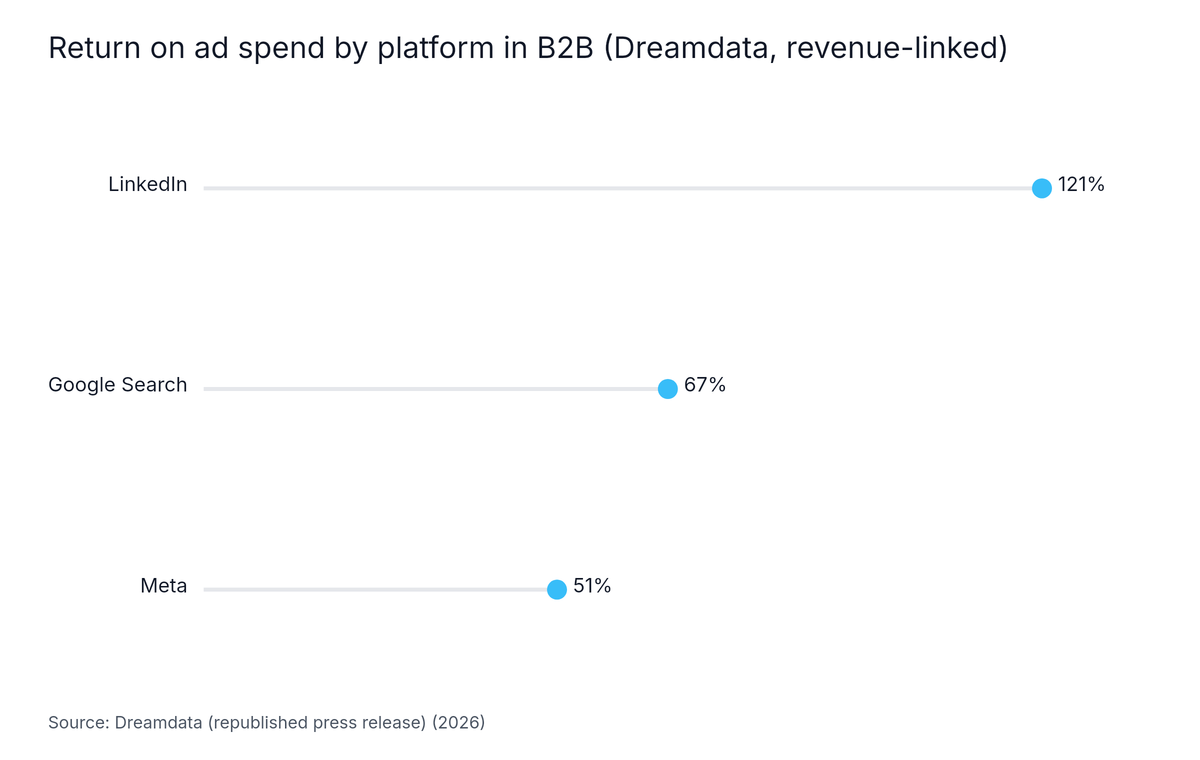
Platform-reported and revenue-linked results can also diverge. On revenue-linked data, return on ad spend was 121% for LinkedIn, 67% for Google Search and 51% for Meta (Dreamdata, 2026). Return on ad spend (ROAS) is revenue divided by ad spend; see the guide to ROAS for B2B SaaS paid media. These are vendor figures, and Dreamdata's own attribution model drives them.
Source: Dreamdata (republished press release), 2026
The chart shows the same three revenue-linked numbers: LinkedIn 121%, Google Search 67% and Meta 51% (Dreamdata, 2026). A channel can look expensive in platform reports and profitable in revenue-linked data, or the reverse.
Auditing GCLID capture means submitting a test lead from a paid click and checking every hand-off: landing URL, form field, CRM record and offline upload. A pass means the same click ID survives each step. In The 2026 B2B SaaS Google Ads Waste Report (GrowthSpree, June 2026), 91% of audited accounts had no GCLID-to-CRM connection.
Google click ID (GCLID) is a unique parameter Google Ads appends to the landing page URL when someone clicks an ad. It is the link between a click and a later CRM outcome. The audit is binary: the value either survives or it does not.
| Step | Pass | Common fail |
|---|---|---|
| Landing URL | Parameter present after all redirects | Redirect or tag manager strips the parameter |
| Form field | Hidden field holds the identical value | Field is empty or truncated |
| CRM lead | Value stored in its own field | Value overwritten or lost on lead conversion |
| Contact and opportunity | Value follows the record | Value stays on the lead and never reaches the deal |
| Offline upload | Stage change triggers a matched upload | Upload errors or no match in Google Ads |
Run the test on each form, each landing page template and each region, since one broken template can silence a whole campaign. A pass on all five steps matters because Google's documentation reports that advertisers who sent first-party data alongside GCLIDs saw a median 10% increase in conversions versus standard offline conversion import (Google Ads Help, 2026), so a GCLID alone is a floor, not a ceiling. The ad account audit process places this check inside a wider review.
The fix sequence for an ad platform and CRM data discrepancy has six steps: agree one SQL definition, capture the GCLID in the CRM, send stage changes back as offline conversions, add first-party data with enhanced conversions for leads, match the measurement view to the sales cycle, and reconcile weekly with the CRM as the system of record. A 90-day fix cut waste from 34.0% to 11.0% (GrowthSpree, June 2026).

Sourced benchmark data: Across 104 B2B SaaS accounts and $78.0M in spend (GrowthSpree, The 2026 B2B SaaS Google Ads Waste Report, June 2026), a 90-day fix moved average Google Ads waste from 34.0% to 11.0% and cut cost per SQL by 62%.
Waste rate is the share of ad spend that produced no qualified pipeline. The steps below take an account from the first number toward the second.
As of June 15, 2026, Google Ads offline conversion import and enhanced conversions for leads uploads moved to the Data Manager API and are blocked in the Google Ads API (Google Ads Help, 2026). Google now describes GCLID-only import as the legacy path and recommends enhanced conversions for leads (Google Ads Help, 2026). Check with whoever owns your upload integration that it no longer calls the old API.
Google's documentation also notes that "Enhanced conversions for web and leads are now combined into a single on/off setting." (Google Ads Help, 2026). The page publishes no sample size for its 10% median lift, so treat that figure as directional.
Both sides must change, or the fix stalls.
| Step | Ad platform setting | CRM configuration |
|---|---|---|
| 1. SQL definition | Choose SQL as the primary conversion goal | Lock one SQL trigger and stage name |
| 2. GCLID capture | Auto-tagging on | Dedicated GCLID field on lead, contact, opportunity |
| 3. Offline conversions | Create offline conversion actions for SQL and closed-won | Stage-change automation that uploads the value through the Data Manager API |
| 4. Enhanced conversions | Enable for leads | Store email and phone cleanly for matching |
| 5. Measurement view | Attribution model and window matched to the cycle | Stage dates recorded for cohort reporting |
| 6. Reconciliation | Export spend and clicks | Pipeline and closed-won report by source |
Three rules keep the two systems from drifting apart again:
For channel-level budget choices after the data is trusted, see ad channels and budget allocation and the Google Ads versus LinkedIn Ads verdict.
The ad platform and CRM data discrepancy guide does not apply cleanly to ecommerce or short-cycle products, and its figures come from vendor and audit datasets, not random samples. The 84-day median sales cycle (Optifai, 2026) covers 939 B2B SaaS companies, and Dreamdata and Chili Piper data reflect their own customer bases.
The limits in plain words:
Google Ads conversion counts differ from CRM lead counts because the ad platform counts every tracked form fill, while the CRM only records leads that passed filtering, deduplication and qualification. Different time windows, click-date versus event-date reporting and lost click IDs widen the gap. The two numbers measure different events, so neither is simply wrong.
A Google click ID (GCLID) is a unique identifier Google Ads adds to a landing page URL when someone clicks an ad. It matters for CRM reporting because storing it on the lead record lets a later SQL or closed-won stage be matched to the exact click and sent back to Google Ads as an offline conversion.
Offline conversion import sends CRM outcomes back to Google Ads using the stored click ID. Enhanced conversions for leads adds hashed first-party data such as email addresses, so a conversion can still match when the click ID is missing. Google's documentation reports a median 10% increase in conversions when first-party data accompanies GCLIDs (Google Ads Help, 2026).
GCLID-only offline conversion import is now described by Google as the legacy path, and Google recommends enhanced conversions for leads, which match on hashed first-party data when a click ID is lost (Google Ads Help, 2026). Since June 15, 2026, offline import uploads must go through the Data Manager API, not the Google Ads API.
The CRM should be the system of record for pipeline, SQLs and closed-won revenue, because it holds the sales-stage outcomes. The ad platform should remain the system of record for spend, impressions and clicks. Assigning one source per metric, and reconciling the two weekly, removes most arguments about whose number is right.
A B2B SaaS Google Ads account should use a window matched to its sales cycle, because default 7-day click attribution captured only 5% to 15% of revenue against an 84-day median sales cycle (GrowthSpree, June 2026). The correct setup captures the GCLID in the CRM, imports SQL and closed-won stages as offline conversions, and uses data-driven or longer attribution.
Ad platforms report more conversions than a CRM because they count every tracked form fill, while the CRM keeps only qualified records. Chili Piper found 14.1% of demo form submissions were disqualified (Chili Piper, 2025), and The 2026 B2B SaaS Google Ads Waste Report found 78% of form fills never reached SQL status (GrowthSpree, June 2026).
A data discrepancy between ad platforms and the CRM is a measurement design problem, not a bug. The platform counts form fills inside a short window. The CRM counts qualified pipeline across a sales cycle of months.
Key takeaways:
Next step: run the five-step GCLID audit this week, then compare the result with the PPC lead generation benchmarks. For a second pair of eyes on your account, Meet with an expert. Free consultation. Bring your ad account questions and brainstorm with a paid media expert.
Written by
Ishan Manchanda
Ishan Manchanda is co-founder of GrowthSpree, a B2B SaaS marketing consultancy founded in 2017 that has managed $60M+ in ad spend across 300+ B2B SaaS companies. He focuses on demand generation, go-to-market strategy and pipeline growth, and has been featured in Silicon Valley Times, SaaS Mag and the Unbounce podcast.
© 2026 adsforb2bsaas.com All rights reserved.