Blog
Offline Conversion Tracking for B2B SaaS: How It Works and Why the Default Setup Fails
Offline conversion tracking sends CRM pipeline back to ad platforms. Learn how the GCLID loop closes, what to set up first, and why 7-day attribution fails.
Google Ads Performance Max for B2B: the settings, budget floor and offline conversion inputs that decide whether PMax drives SQLs or wastes spend.
 Ishan ManchandaNov 10, 2026

Offline conversion tracking sends CRM pipeline back to ad platforms. Learn how the GCLID loop closes, what to set up first, and why 7-day attribution fails.

Tools to detect wasted ad spend in Google Ads, mapped to the signal each one exposes, with a triage order for B2B SaaS accounts above 30% waste.
Learn how to reduce wasted ad spend in B2B SaaS: causes, a waste rate formula, quartile benchmarks and a prioritised fix list that keeps total budget.
Request a quote and our experts will contact you within 24 hours with tailored solutions and pricing.
Last updated: Nov 10, 2026
Performance Max (PMax) is a Google Ads campaign type that works for B2B SaaS only when offline conversions feed it sales-qualified lead (SQL) data and the budget funds enough conversions to learn. A June 2026 audit of 104 B2B SaaS accounts and $78.0M in spend (GrowthSpree, The 2026 B2B SaaS Google Ads Waste Report) found PMax cost per SQL of $2,140 running blind, against $620 with offline conversions connected. This guide covers the settings behind that gap, the budget math for small accounts, and the cases where Search should come first. For accounts already leaking budget, start with a wasted spend diagnosis.
Key Takeaways
- Performance Max for B2B SaaS depends on two inputs: CRM-connected offline conversions and enough budget to learn. The 2026 audit measured $2,140 versus $620 cost per SQL.
- Platform cost per lead misleads on PMax: $25 against $143 for Search in one B2B SaaS dataset, while 78% of audited form fills never reached SQL.
- A small B2B budget needs about 30 conversions a month at the optimized event, roughly $6,210 on form fills at $207 non-brand cost per lead (a derived estimate).
- Brand exclusions, Customer Match lists from closed-won deals and a few well-fed asset groups keep PMax honest. Below the budget floor, Search should run first.
Performance Max (PMax) works for B2B SaaS only under two conditions: offline conversions feed closed-loop SQL data back to Google, and the budget funds enough conversions for bidding to learn. The 2026 B2B SaaS Google Ads Waste Report (GrowthSpree, June 2026) audited 104 accounts and found PMax cost $2,140 per SQL running blind versus $620 with offline conversions.

Performance Max (PMax) is a Google Ads campaign type that uses automated bidding to serve one set of assets across Search, YouTube, Display, Discover, Gmail and Maps. A sales-qualified lead (SQL) is a lead that sales has accepted as a real buying prospect. Adoption keeps rising: PMax campaign volume grew 15.7% year over year in Optmyzr's Q1 2026 benchmark of more than 21,000 accounts (Search Engine Journal, 2026).
Automation optimizes whatever it is fed. For B2B SaaS, the setup decides the result more than the campaign type does. For the wider channel picture, see PPC lead generation for B2B SaaS.
| Setting | Why it decides the result | Evidence |
|---|---|---|
| Conversion inputs | PMax bids toward whichever conversion it receives | $2,140 versus $620 cost per SQL (GrowthSpree, June 2026) |
| Budget floor | Bidding needs conversion volume to learn | Google advises at least 6 weeks without major changes (Google Ads, 2025) |
| Audience signals and asset groups | They set the starting data and how conversions are split | Segment only where each group can collect conversions |
| Brand exclusions | Brand traffic inflates PMax results | Brand leads cost $34 against $207 non-brand (PipeRocket Digital, 2026) |
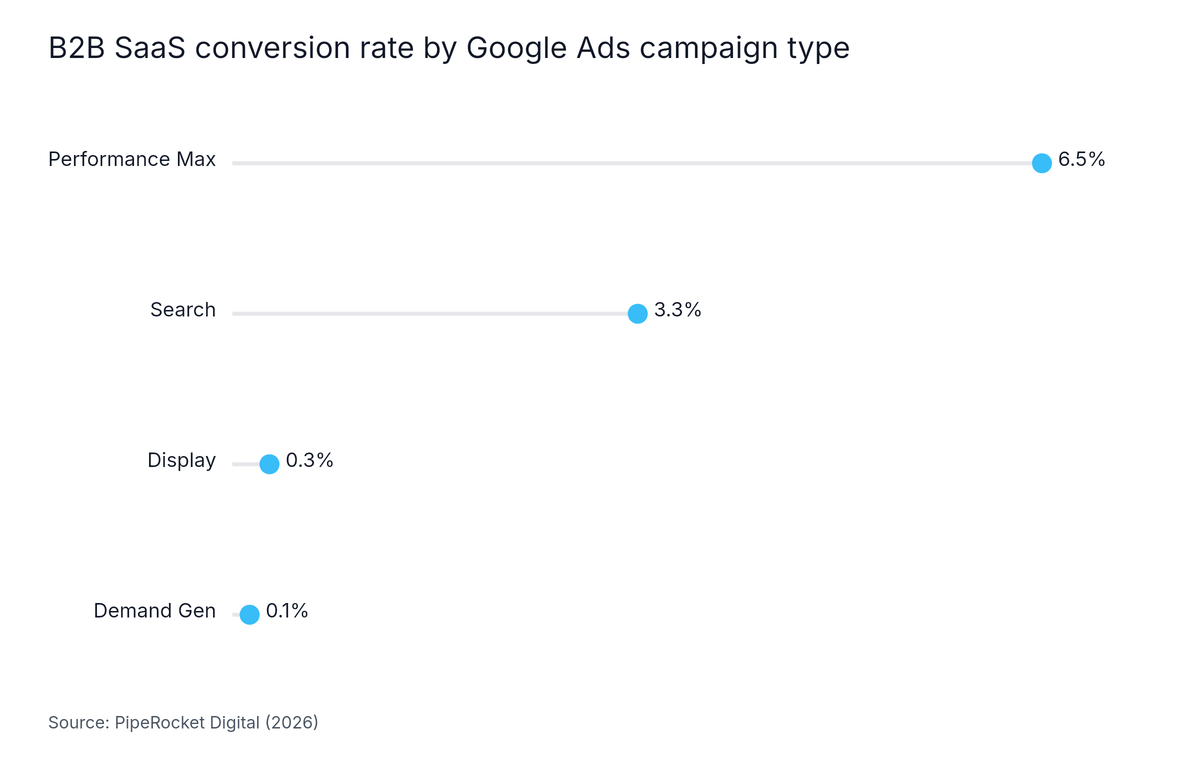
PMax also converts at a higher platform rate: 6.53% against 3.27% for Search in the same B2B SaaS dataset (PipeRocket Digital, 2026). Volume metrics alone will flatter it.
Source: PipeRocket Digital, 2026
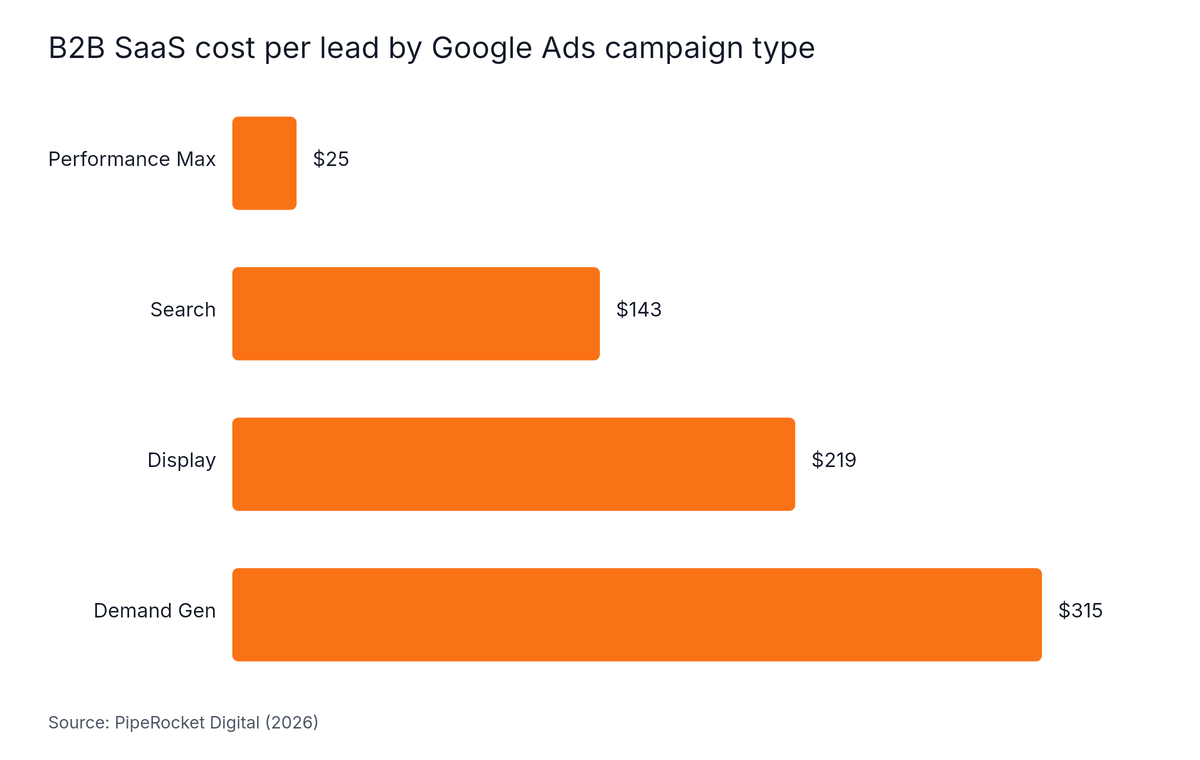
Performance Max looks cheap because it optimizes toward form fills, and most form fills never become pipeline. In a PipeRocket Digital dataset of 53+ B2B SaaS accounts, PMax cost per lead was $25 against $143 for Search (PipeRocket Digital, 2026). The 2026 B2B SaaS Google Ads Waste Report found 78% of form fills never reach SQL status (GrowthSpree, June 2026).
Waste rate is the share of ad spend that produces no qualified pipeline. In that report, the average Google Ads waste rate was 34.0%, about $255K per account per year. PMax without offline conversions and broad match without negative keywords together accounted for 56% of documented waste (GrowthSpree, June 2026).
Source: PipeRocket Digital, 2026
A $25 lead looks efficient in the dashboard. It only means something if the lead reaches sales, so cost per SQL, not cost per lead, is the number to judge PMax on. The same trap is covered in ROAS for B2B SaaS paid media.
Sourced benchmark data: The 2026 B2B SaaS Google Ads Waste Report (GrowthSpree, June 2026, 104 accounts, $78.0M in spend) found 91% of accounts had no GCLID-to-CRM connection. PMax cost per SQL was $2,140 running blind versus $620 with offline conversions. A 90-day fix moved average Google Ads waste from 34.0% to 11.0% and cut cost per SQL by 62%.
Bots and spam leads can drain a PMax budget, but no independent B2B SaaS data on PMax spam rates exists. The available figures come from vendors that sell detection. In a Lunio survey of 131 senior marketers, 75.6% estimated losing more than 5% of monthly performance budget to bots, while 5.3% ran a dedicated invalid-traffic platform (PPC Land, 2026).
Treat these as directional. Lunio's retail findings put invalid traffic on AI Max search campaigns at 5.28% in Q2 2026, against 3.07% for standard search (PPC Land, 2026). That is retail, not PMax, and a correlation only. The takeaway is narrow: automation that expands queries can raise junk traffic, so validate leads before importing them as conversions.
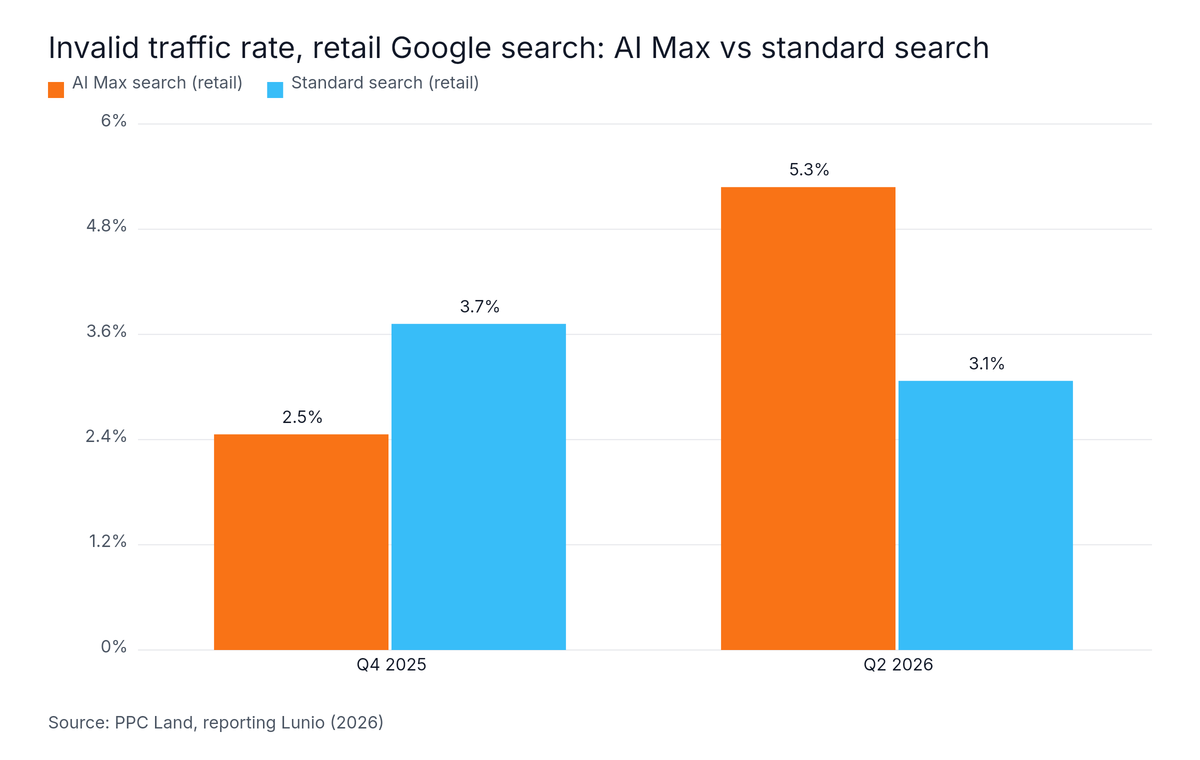
Source: PPC Land, reporting Lunio, 2026
Offline conversions are sales outcomes, such as SQL or closed-won, that a CRM sends back to Google Ads by matching the Google click ID (GCLID) saved with each form fill. They let PMax bid toward leads sales accepts. The 2026 B2B SaaS Google Ads Waste Report (GrowthSpree, June 2026) found cost per SQL fell from $2,140 to $620 once they were connected.

The Google click ID (GCLID) is a unique identifier Google appends to a landing page URL so a later sales outcome can be matched to the original ad click. Yet 91% of audited accounts had no GCLID-to-CRM connection, and 89% ran default attribution before the audit (GrowthSpree, June 2026). Closing that one gap is the highest-value change in most B2B SaaS PMax accounts.
PMax should optimize the deepest event that still gets enough volume. Google's lead-generation guidance says: "Optimize to deeper funnel conversion actions where possible." (Google Ads, 2025). Use this ladder as a starting point.
| Event | Role in PMax | Use it when |
|---|---|---|
| Form fill | Fallback signal, ideally secondary | Volume is too low for anything deeper |
| MQL | Primary event for small budgets | SQL volume is under the learning floor |
| SQL | Primary event for funded accounts | You can reach about 30 a month |
| Closed-won | Value signal and Customer Match source | Deals are large and the cycle is long |
A broken link looks like Google reporting 200 conversions while sales sees 12 real leads. Check it in this order:
One lead-generation case shows what the fix can do, though it is not B2B SaaS. PMax's qualified-lead rate was 5% until a HubSpot link via GCLID was added. It reached 10% after two weeks and 20% after six weeks, against a Search baseline of 25% (DataFeedWatch, 2026). Treat it as illustrative, not a benchmark.
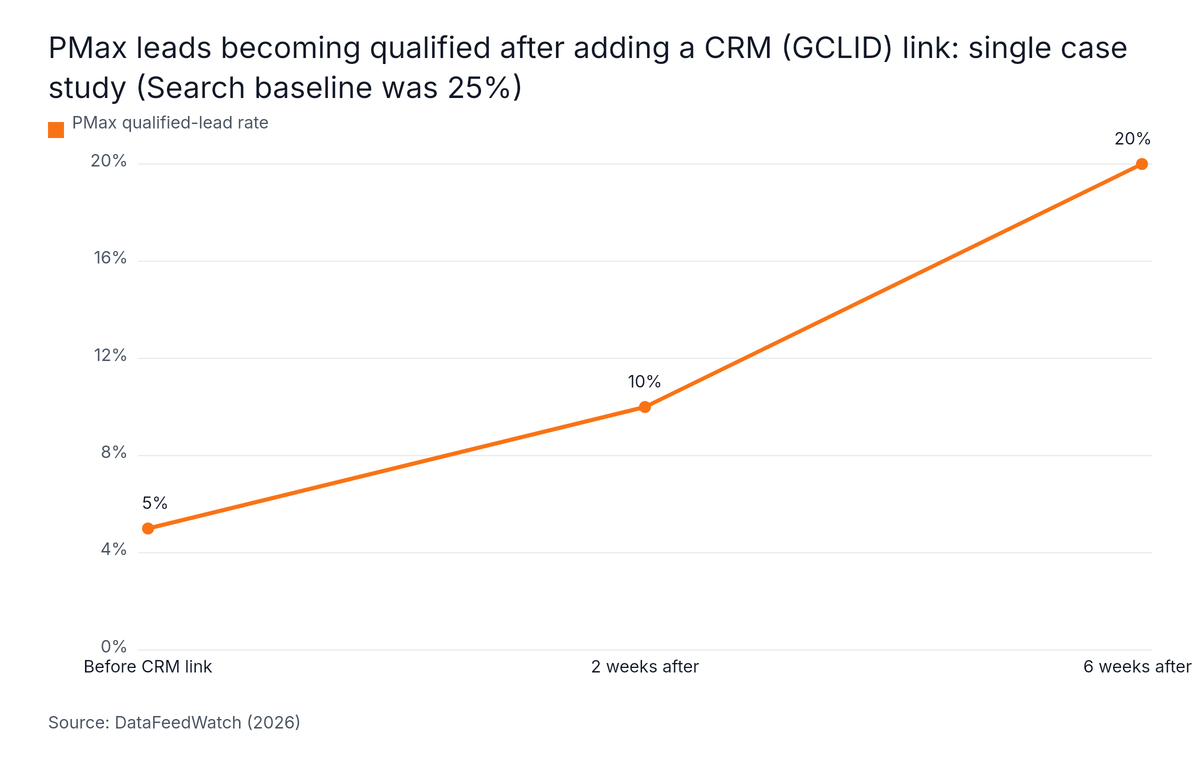
Source: DataFeedWatch, 2026
Performance Max can be worth running with a long sales cycle only if conversion data covers the lag between click and SQL. The median B2B SaaS cycle is 84 days, up 22% since 2022 (Apollo.io, 2026), and default 7-day click attribution captures just 5% to 15% of revenue (The 2026 B2B SaaS Google Ads Waste Report, GrowthSpree, June 2026). Short windows starve the algorithm of the outcomes that matter.

| Factor | Figure | What it means for PMax |
|---|---|---|
| Median sales cycle | 84 days (Apollo.io, 2026) | A click in week one may not become an SQL before week twelve |
| Buying committee size | 6.8 stakeholders, up from 5.4 (Apollo.io, 2026) | SQL signals arrive weeks after the first click |
| Default 7-day click window | 5% to 15% of revenue captured (GrowthSpree, June 2026) | Set windows and imports to match the real cycle |
| Cycle by deal tier | 90 to 180+ days over $100K ACV, 14 to 30 days under $15K ACV (Webtonic, 2026) | Choose the optimization event by annual contract value (ACV) tier |
The practical rule: set the conversion window and import cadence to cover the cycle, and import closed stages as they change. Teams with a short cycle can optimize on SQL sooner. Teams with a long one often need MQL as a proxy first. Channel tradeoffs sit in ad channels and budget allocation for B2B SaaS.
A small B2B budget should run Performance Max only when it can fund roughly 30 conversions a month at the event being optimized. Google publishes no minimum budget, and Google's lead-generation guidance says to leave a PMax campaign alone for at least 6 weeks (Google Ads, 2025). At PipeRocket Digital's $207 non-brand cost per lead, 30 form fills is about $6,210 a month (a derived estimate).

The 30-conversion figure is a practitioner rule of thumb, not a Google requirement. Every monthly floor below is writer arithmetic: cost per conversion multiplied by 30.
| Optimization event | Cost per conversion | Monthly floor for 30 conversions (derived) |
|---|---|---|
| Form fill, non-brand | $207 (PipeRocket Digital, 2026) | $6,210 ($207 x 30) |
| SQL, with offline conversions | $620 (GrowthSpree, June 2026) | $18,600 ($620 x 30) |
| SQL, running blind | $2,140 (GrowthSpree, June 2026) | $64,200 ($2,140 x 30) |
Mid-sized spend appears to help. Accounts spending $10K to $50K a month reached a 566% ROAS tier, roughly 50% above SMB and enterprise segments, across all campaign types (Search Engine Journal, 2026).
Four settings decide a B2B SaaS PMax campaign: the conversion event it optimizes, the audience signals it starts from, the asset group structure, and brand exclusions. Brand matters most for measurement: non-brand leads cost $207 against $34 for brand in a 53+ account B2B SaaS dataset (PipeRocket Digital, 2026), so unchecked brand traffic flatters PMax.

| Setting | Do | Skip |
|---|---|---|
| Audience signals | Customer Match from closed-won deals, remarketing lists, custom segments built from ideal customer profile (ICP) URLs | Broad interest lists with no link to the ICP |
| Asset groups | One group per product or ICP, only if each can collect conversions | Splitting by persona when volume is thin |
| Brand exclusions | Exclude brand terms and review the search terms report | Judging PMax on blended results |
| Search overlap | Check overlap with Search campaigns | Letting PMax and Search bid on the same queries unchecked |
Start from first-party data. Google's guidance says: "Set your lead generation goals to New Customer Only Mode if you only want to target new customers." (Google, 2025). The mode requires a Customer Match list, and Google's reported gains from it are a vendor claim with no stated sample. Build the list from closed-won deals, not every lead.
Fewer than most guides suggest. Optmyzr's study of 24,702 PMax campaigns concludes: "There is no right answer on whether to segment your PMax campaigns through asset groups or a separate campaign." (Optmyzr, 2026). A common practitioner rule of thumb is to merge groups with fewer than 10 conversions in 30 days. Creative quality still matters: see ad creative best practices for B2B SaaS.
Google introduced channel performance reporting, full search terms reporting and detailed asset reporting for PMax in April 2025 (Google, 2025), which makes waste auditable. Google also began auto-upgrading eligible legacy Search campaigns to AI Max on September 1, 2026 (PPC Land, 2026), so recheck how brand and non-brand queries split between campaigns.
Performance Max is not for B2B SaaS teams that cannot send CRM outcomes back to Google Ads, cannot fund about 30 monthly conversions at the optimized event, or sell into a small niche audience. In The 2026 B2B SaaS Google Ads Waste Report (GrowthSpree, June 2026), 91% of audited accounts had no GCLID-to-CRM connection. For these teams, Search keeps control of queries while conversion history builds.
Be careful with the evidence too. The audit figures come from one set of 104 accounts and $78.0M in spend, so the $620 and $2,140 figures show a gap in that sample, not a promise for any account. The Lunio invalid-traffic findings come from a vendor that sells detection, and mostly cover retail. The DataFeedWatch case is a single non-B2B account.
Counterpoints exist as well. Optmyzr's Q1 2026 benchmark reports PMax click-through rate rising from 1.29% to 1.68% while cost per acquisition also rose and ROAS slipped slightly (Search Engine Journal, 2026). Teams unsure whether Google fits at all should compare it with LinkedIn Ads for B2B SaaS.
A small B2B budget should run Performance Max only when it can fund about 30 conversions a month at the event being optimized, a practitioner rule of thumb rather than a Google minimum. At PipeRocket Digital's $207 non-brand cost per lead (2026), that is roughly $6,210 a month on form fills (a derived estimate). Below that, Search with exact and phrase match gives more control.
Performance Max is worth running for a B2B company with a long sales cycle only when SQL and closed-won data flow back to Google Ads through offline conversions. The median B2B SaaS cycle is 84 days (Apollo.io, 2026), and a default 7-day click window captures only 5% to 15% of revenue (GrowthSpree, June 2026). Without longer windows and CRM imports, PMax optimizes for form fills.
Performance Max can generate B2B leads, but it wastes spend when it optimizes for form fills. The 2026 B2B SaaS Google Ads Waste Report (GrowthSpree, June 2026) found PMax cost $2,140 per SQL running blind and $620 with offline conversions, and 78% of form fills never reached SQL status. CRM outcomes and brand exclusions decide whether the leads are real.
Performance Max is suitable for B2B marketing when the account has CRM-connected conversion data, enough monthly volume to learn, and brand exclusions in place. It is a poor fit for teams with tiny niche audiences or no offline conversion tracking, where Search offers more control. Google's lead-generation guidance asks for at least 6 weeks without major changes (Google Ads, 2025).
A B2B team should leave a Performance Max campaign alone for at least 6 weeks before making major changes, according to Google's lead-generation guidance (Google Ads, 2025). The budget has to fund that whole window, and with an 84-day median sales cycle the first SQL signals may arrive after it ends. Judge early progress on leading events.
Performance Max (PMax) is neither broken nor automatic for B2B SaaS. Five points carry the decision:
Next step: Meet with an expert. Free consultation. Bring your ad account questions and brainstorm with a paid media expert. For a self-serve review first, use the ad account audit checklist.
Written by the Ads for B2B SaaS paid media editorial team; reviewed by a paid media editor before publication. Last updated: October 28, 2026. Method: every figure names its study, sample and date beside it. Audit figures are from GrowthSpree's The 2026 B2B SaaS Google Ads Waste Report (June 2026, 104 accounts, $78.0M spend).
Written by
Ishan Manchanda
Ishan Manchanda is co-founder of GrowthSpree, a B2B SaaS marketing consultancy founded in 2017 that has managed $60M+ in ad spend across 300+ B2B SaaS companies. He focuses on demand generation, go-to-market strategy and pipeline growth, and has been featured in Silicon Valley Times, SaaS Mag and the Unbounce podcast.
© 2026 Ads for B2B SaaS All rights reserved.

