how to implement remarketingB2B SaaS remarketing windowremarketing audiences from CRM stages
How to Implement Remarketing for B2B SaaS: Audiences, Windows and Channels That Match a Long Sales Cycle
Learn how to implement remarketing for B2B SaaS: build CRM-stage audiences, set windows from real deal timelines and pick Google, LinkedIn or programmatic.
Request a quote and our experts will contact you within 24 hours with tailored solutions and pricing.
How to Implement Remarketing for B2B SaaS: Audiences, Windows and Channels That Match a Long Sales Cycle
Remarketing for B2B SaaS is the practice of showing ads to people and accounts that already visited your site or sit in your CRM, with audiences built from deal stage and windows set to the real sales cycle. This guide explains how to implement remarketing that way.
The default 30-day window is the usual mistake. The median B2B SaaS sales cycle is 84 days (Optifai, 2026), so a 30-day list mostly refills with early-stage visitors who never converted the first time. You get the setup steps, window math by deal size, CRM-stage audiences, channel thresholds and a holdout design. For the tracking groundwork, start with the ad account audit checklist.
Key Takeaways
B2B SaaS remarketing works best when audiences follow CRM deal stage, not just page visits.
The default 30-day remarketing window is too short for deals above $15K ACV, where cycles run 30 to 180 or more days.
Audience minimums decide channel choice for B2B SaaS remarketing: 300 matched members on LinkedIn, 1,000 for Google Search remarketing, 100 for Google Display.
Default 7-day click attribution captures only 5% to 15% of revenue against an 84-day median cycle, so connect CRM data before judging remarketing results.
A holdout test is the only reliable way to tell whether B2B retargeting adds pipeline or just claims credit.
How do you implement remarketing for a B2B SaaS product?
Implementing remarketing for a B2B SaaS product takes five steps: install tracking and capture the Google click ID (GCLID) in the CRM, sync deal stages into audience lists, set a window for each stage from real deal timelines, choose Google, LinkedIn or programmatic by audience size, and measure with a holdout. The median B2B SaaS sales cycle is 84 days (Optifai, 2026).
Five paper index cards fanned out in a staircase, each with a different colored tab, arranged in order on a desk
Remarketing is the practice of serving ads to people or accounts that have already interacted with your site, product or sales team. In B2B SaaS the interaction that matters is not a page view. It is a CRM stage, a named step in the deal pipeline such as discovery or negotiation.
Two more terms appear in every step. The Google click ID (GCLID) is a unique parameter Google appends to ad-click URLs, which lets a CRM match a lead to the click that produced it. A sales-qualified lead (SQL) is a lead that sales has accepted as a real buying opportunity.
Follow the steps in order, because each depends on the one before it:
Capture identity. Install the ad platform tags and store the GCLID with every form fill so the CRM can match leads to ad clicks.
Sync stages. Send contacts and accounts to the platforms by opportunity stage, and refresh the lists on a schedule.
Set windows. Derive a window per audience from stage-duration data, not from a generic default.
Pick channels. Match each audience to a channel that can serve it at its size.
Prove lift. Hold out a random share of each audience and compare SQL rates.
Step
What to do
Why it matters
1. Capture identity
Store the GCLID in the CRM with each lead
91% of audited accounts had no GCLID-to-CRM connection (GrowthSpree, The 2026 B2B SaaS Google Ads Waste Report, June 2026)
2. Sync stages
Upload lists by CRM stage
Ads match where the buyer actually is
3. Set windows
Use stage duration and ACV band
A default 30 days misses long cycles
4. Pick channels
Check minimum list sizes first
Lists below platform minimums never serve
5. Prove lift
Run a holdout per audience
Stops retargeting from taking credit for organic closes
Our results: Across 104 B2B SaaS accounts and $78.0M in spend, 89% ran default attribution before an audit, and 78% of form fills never reached SQL status (GrowthSpree, The 2026 B2B SaaS Google Ads Waste Report, June 2026). Remarketing built on form fills alone inherits that noise.
Skipping step 1 is the most common failure. Without the click ID in the CRM, the later steps cannot be tied to closed-won revenue. The wasted ad spend diagnosis guide covers the fix in detail.
Is a 30-day remarketing window too short for B2B SaaS, and how long should it be?
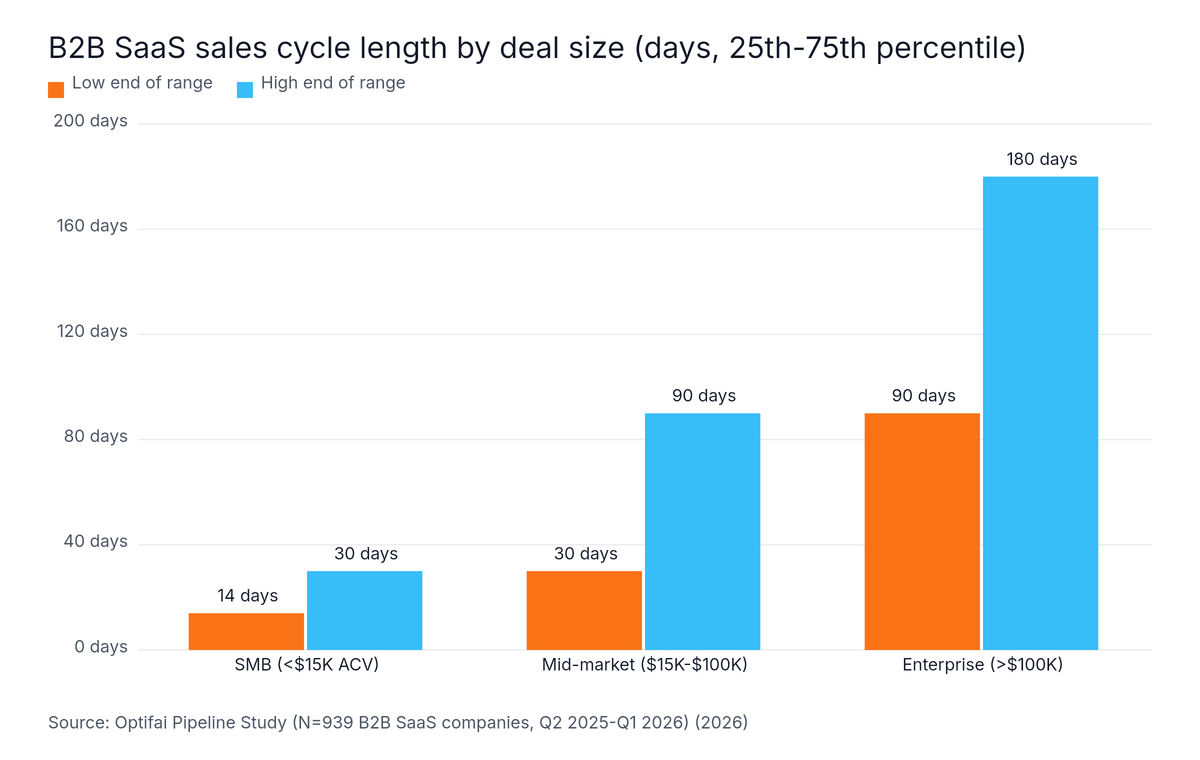
A 30-day remarketing window is too short for most B2B SaaS deals above $15K in annual contract value (ACV). Optifai's study of 939 companies puts the median cycle at 84 days, with mid-market deals running 30 to 90 days and enterprise deals 90 to 180 or more (Optifai, 2026). Set the window ceiling to the upper bound of your ACV band, then shorten it by intent.
A wall calendar with a long run of weeks highlighted in teal next to one short week marked in rust
Annual contract value (ACV) is the yearly revenue a single customer contract brings in. It is the best single predictor of how long a deal will take, so it should drive your window.
Why a 30-day window recycles early-stage visitors
Most visitors in a 30-day list are researchers who read one blog post. Buyers moving toward a purchase take weeks to bring in colleagues, so the window drops them before the decision. Gartner's 2025 survey of 632 buyers found B2B buying groups range from five to 16 people across up to four functions (Outreach Bloom, citing Gartner, 2025). A buying committee is the group of people across functions who take part in a B2B purchase, and each member visits on a different day.
Optifai reports that sales cycles have lengthened 22% since 2022 and that committees grew from 5.4 to 6.8 stakeholders (Optifai, 2026). The 2026 B2B SaaS Google Ads Waste Report (GrowthSpree, June 2026) cites buying committees of 6 to 10 people. The range differs by source, but all point the same way: more people, more time.
Grouped Bar chart: B2B SaaS sales cycle length by deal size (days, 25th-75th percentile). Highest: Enterprise (>$100K) at 90 days.
The chart shows cycle length by deal size: SMB deals under $15K close in 14 to 30 days, mid-market deals ($15K to $100K) in 30 to 90 days, and enterprise deals (over $100K) in 90 to 180 or more. Optifai sells sales software, so treat the data as a vendor dataset and present 84 days as a median, not a universal figure.
How to derive a window from CRM data
The method is simple: measure how long deals actually take, then size each window to that.
ACV band
Typical cycle (Optifai, 2026)
Suggested window ceiling
Under $15K
14 to 30 days
30 days
$15K to $100K
30 to 90 days
90 days
Over $100K
90 to 180+ days
180 days
These ceilings are starting points that follow from the cited cycle ranges. Refine them with your own CRM: pull the time from first site visit to SQL and from SQL to closed-won, then take the upper quartile of each stage as that stage's window.
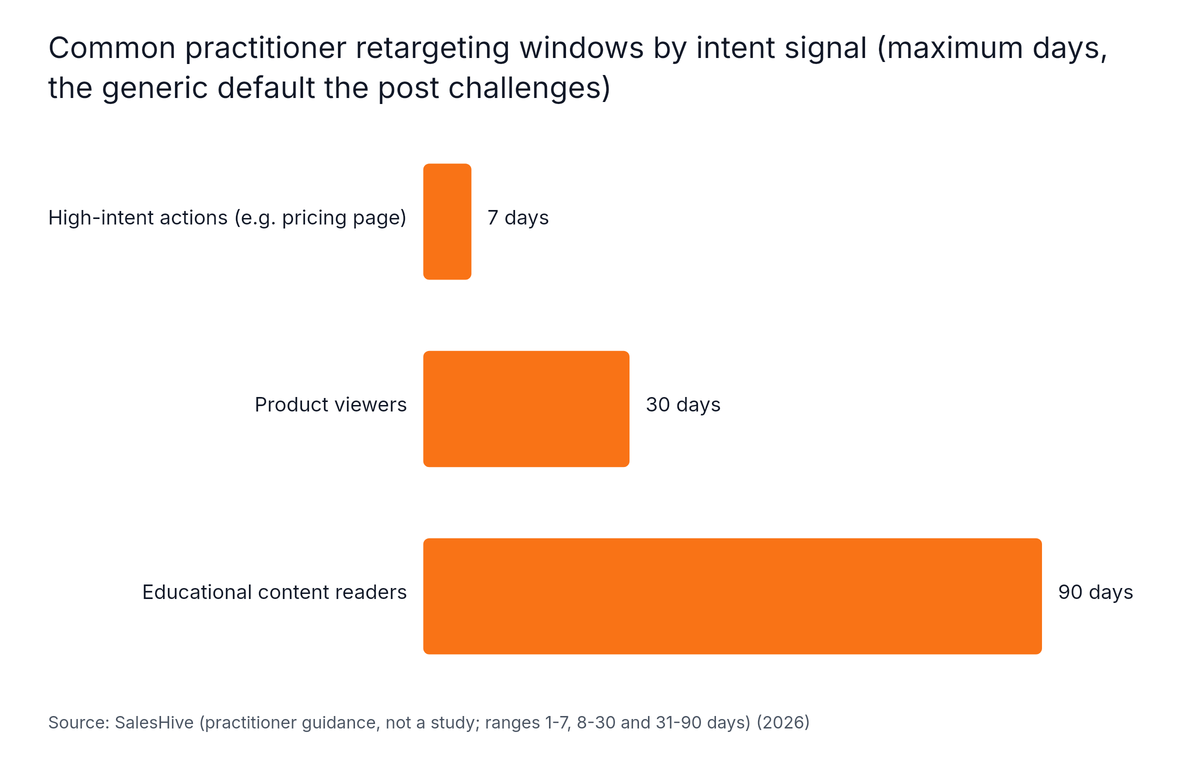
Intent should shorten the window inside the ceiling. Common practitioner guidance, charted below and not a study, caps high-intent actions such as pricing page visits at about 7 days, product viewers at 30 and educational readers at 90. That is the generic default this guide argues against for long cycles.
Horizontal Bar chart: Common practitioner retargeting windows by intent signal (maximum days, the generic default the post challenges). Highest: Educational content readers at 90 days.
Use the chart as a baseline for the shortest tier only. A pricing-page visitor in an enterprise deal still belongs in a bottom-of-funnel audience, but the account behind that visit should stay in a longer list. The source for the chart is SalesHive (2026).
How do you build remarketing audiences from CRM stages?
Building remarketing audiences from CRM stages means exporting contacts and accounts by opportunity stage, uploading them as lists, and moving people between lists when the stage changes. Google Ads Customer Match supports this with a membership life span of 0 to 540 days (Google for Developers, 2026), and LinkedIn accepts contact and company lists.
File folders in graduated colors, gold at the front and teal at the back, lined up on a long shelf
Google Ads Customer Match is a feature that lets advertisers upload first-party contact lists, such as CRM exports, and target or exclude those people. The platform ceiling is stated plainly in the API documentation: "Membership life span must be between 0 and 540 days inclusive." (Google Ads API documentation, 2026). That is longer than almost any B2B SaaS cycle, so the CRM, not the platform, sets your window.
A CRM-stage audience map
An ideal customer profile (ICP) is the description of the companies most likely to buy and succeed with the product. It anchors the first audience below.
Audience
CRM trigger
Message focus
Exclude
Known ICP, no opportunity
Lead at an ICP account, no meeting
Problem education, proof
Existing customers, never-fit accounts
Engaged evaluators
Pricing or demo-page visit, no SQL
Demo offer, comparisons
Open opportunities
Open opportunity
Stage: discovery to negotiation
Sales-support content for the committee
Closed-won customers
Closed-lost
Lost within the window
Re-engagement, new features
Never-fit accounts
Closed-won
Contract signed
Onboarding, expansion (not acquisition ads)
Excluded from all acquisition lists
Exclusions matter as much as inclusions. Buyers in an open opportunity should not see top-of-funnel ads, and customers should not see acquisition offers. Build a rule so that when a contact's stage changes, the sync removes them from the old list and adds them to the new one.
Refresh cadence is a practical limit. A list that updates monthly leaves buyers in the wrong audience for weeks. Match refresh frequency to the speed of your shortest stage. Google also states that Customer Match lists need at least 100 members added or updated within 540 days to stay eligible, so a stale list can lapse.
Account-level audiences for buying committees
Because several people from one company evaluate the product, account lists matter more than individual lists. Upload company lists to LinkedIn and match contact emails for Google so that every stakeholder sees consistent messaging, even if only one of them visited the site. Gartner's May 2026 survey of B2B buyers found they use about seven sources per purchase (Gartner, 2026), which supports repeating a consistent message between research and sales contact.
Should B2B SaaS use Google, LinkedIn or programmatic remarketing?
Audience size and ACV decide the channel for B2B SaaS remarketing. LinkedIn needs at least 300 matched members (Stackmatix, 2026), Google Search remarketing (RLSA) needs 1,000 active members, and Display needs 100 active visitors in the last 30 days (Gidds Media, 2026). Programmatic has no credible public benchmark, so test it last.
Three glass funnels of small, medium and large size in a row on a table with colored sand passing through
Remarketing lists for search ads (RLSA) show Google Search ads, or adjust bids, for people already on a remarketing list. Small B2B SaaS lists often miss the 1,000-member threshold, so Display or LinkedIn tends to serve first.
Channel
Minimum audience
Cost signal
Best fit
Google Display remarketing
100 active visitors in 30 days
Varies by account
Small site traffic, stage-based lists
Google Search (RLSA)
1,000 active list members
Non-brand CPC for B2B SaaS is $8.50 to $14.00 (GrowthSpree, SaaS Google Ads Benchmarks 2026, April 2026)
Bidding up on known visitors who search
LinkedIn Matched Audiences
300 matched members
Average CPM $60, CPC $10.11, CPL $276 across 87 B2B accounts (42 Agency, 2026)
High-ACV deals, account and role targeting
Programmatic
No verified public minimum
No verified public benchmark
Account-based reach at scale, after the above are saturated
LinkedIn is a high-cost channel, so it suits higher ACV. Its benchmarks vary widely by source, so check them against your own account. The thresholds above come from secondary sources describing platform rules, so confirm them in Google Ads Help and LinkedIn Campaign Manager before you plan lists around them. The website lookback ceiling for LinkedIn is reported inconsistently, from 180 to 365 days.
One more check: LinkedIn budget often lands on the wrong people. In audited accounts, decision-makers received only 33% of LinkedIn budget against a 60%+ target (GrowthSpree, Wasted LinkedIn Ads Spend in B2B SaaS, June 2026). CRM-based lists push spend toward the roles that actually sign.
Does retargeting actually work for B2B, and how do you measure incrementality?
Retargeting works for B2B only to the extent it adds pipeline that would not have closed anyway, and a holdout test is the way to find out: hide ads from a random slice of an audience and compare sales-qualified lead rates. Default 7-day click attribution captures only 5% to 15% of revenue against an 84-day median cycle (GrowthSpree, The 2026 B2B SaaS Google Ads Waste Report, June 2026).
Two matching trays of marbles separated by a divider, one tray tinted gold, with tweezers lifting one marble
Platform dashboards over-credit remarketing because the people on these lists were already close to buying. Buyers also research widely: Gartner's May 2026 survey found they use about seven sources per purchase (Gartner, 2026), so many touches compete for credit.
The counter-view is worth taking seriously. One practitioner advises: "Cap frequency, shrink the audience window, and run a holdout before you believe the ROAS number on the dashboard." (DemandBox, 2026). That conflicts with the long-window thesis in this guide, and the honest answer is that both can be true. A long window only helps if the extra days add incremental SQLs, which is exactly what a holdout shows. For background on the metric, see what ROAS means for B2B SaaS.
Our results: Across 1,412 ad variants, 96 accounts and $14.2M in spend, click-through rate (CTR) correlated with pipeline at r = 0.09, cost per lead (CPL) at r = 0.23 and cost per SQL at r = 0.71. In 43% of A/B tests, the higher-CTR winner produced fewer or costlier SQLs (GrowthSpree, The Paid Ads Pipeline Disconnect, June 2026). Judge remarketing by cost per SQL and closed-won, not by click rate.
A holdout design for small B2B audiences
A holdout test hides ads from a random share of an audience and compares its outcomes with the exposed group. For small lists and long cycles:
Split each audience at random into exposed and holdout groups, keeping the holdout small enough to protect reach.
Run for at least one full typical stage duration, not a week.
Compare SQL rate and pipeline created per account, not clicks.
Re-check after closed-won data arrives, since deals can take 84 days or longer.
If lift is near zero, shorten the window or cut the audience.
Frequency caps are a separate test. Published guidance conflicts (3 to 5 per week in some guides, 5 to 12 per week in others) with no study behind either, so treat any cap as a hypothesis.
When is remarketing not worth building for B2B SaaS?
Remarketing is not worth building for B2B SaaS when the audience is too small, tracking is broken, or consent is missing. Platform minimums of 100 to 1,000 members block small lists, and 91% of audited accounts had no GCLID-to-CRM connection (GrowthSpree, The 2026 B2B SaaS Google Ads Waste Report, June 2026), which makes stage-based audiences impossible until that is fixed.
Honest limits to weigh before you start:
Small traffic. If fewer than 100 qualified visitors arrive in 30 days, Google Display lists will not serve, and CRM uploads become the only practical source.
Source quality. Several figures here come from vendor datasets or secondary pages. The 84-day median is a vendor figure, and other sources report longer segment averages, so check your own CRM.
Programmatic data gap. No credible public benchmark exists for B2B programmatic audience sizes, match rates or incrementality.
Privacy and consent. On 22 April 2025 the Google Privacy Sandbox team said it would "maintain our current approach to offering users third-party cookie choice in Chrome" (AdSovereign, quoting the Privacy Sandbox blog, 2025). Google then announced on 17 October 2025 that it would retire most Privacy Sandbox technologies, as reported by a secondary source (2025). Cookies are not going away on the old schedule, but consent rules in the UK, EU and Canada still shrink audiences, so check your consent setup.
Fewer human visitors. A Gartner forecast, reported by a secondary source and not verified at the primary page, says AI agents may intermediate most B2B buying by 2028, which could thin the pool of human visitors to retarget. Treat that as a hedge, not a plan.
If your account still has broad tracking gaps, fix attribution first. The PPC lead generation guide shows what good looks like before you add remarketing spend.
Frequently Asked Questions
What is the minimum audience size for LinkedIn retargeting?
LinkedIn requires at least 300 matched members before a Matched Audience, including website, contact and account lists, will serve ads, according to a 2026 Stackmatix guide citing LinkedIn specifications. Confirm the figure in Campaign Manager, because the maximum website lookback window is reported inconsistently across sources, from 180 to 365 days.
What is the maximum membership duration for Google Ads Customer Match lists?
Google Ads Customer Match lists can keep members for up to 540 days. The Google Ads API documentation states that membership life span must be between 0 and 540 days inclusive. That ceiling is longer than most B2B SaaS sales cycles, so the limit rarely forces a shorter window.
How big does a Google remarketing list need to be before ads serve?
Google Search remarketing (RLSA) needs a list of at least 1,000 active members, while Display remarketing ads will not serve without at least 100 active visitors in the last 30 days, according to a 2026 Gidds Media explainer of Google's thresholds. Verify both in Google Ads Help before building audiences.
Should B2B SaaS remarketing exclude open opportunities and customers?
Yes. B2B SaaS remarketing should exclude closed-won customers from acquisition ads and move open opportunities into a separate audience that gets sales-support content instead of top-of-funnel offers. Without exclusions, buyers already talking to sales keep seeing demo-request ads, which wastes spend and can confuse the buying committee.
What frequency cap should B2B SaaS retargeting ads use?
No verified benchmark exists for B2B SaaS retargeting frequency caps, and published guidance conflicts, with LinkedIn suggestions ranging from 3 to 5 per week in some guides and 5 to 12 per week in others. Treat any cap as a hypothesis, start low, and validate it with a holdout test.
Conclusion
Remarketing for B2B SaaS works when audiences follow the CRM and windows follow the deal. The default 30-day window fits short consumer cycles, not an 84-day median. Five points to carry forward:
Capture the GCLID in the CRM first, or nothing downstream can be tied to closed-won.
Size each window to your ACV band and stage durations, from 30 days for small deals up to 180 days for enterprise.
Build lists by CRM stage, with exclusions for open opportunities, customers and never-fit accounts.
Choose channels by list size: 300 members for LinkedIn, 1,000 for RLSA, 100 for Display, and test programmatic last.
Prove incrementality with a holdout, and judge results by cost per SQL.
Next step: bring your audience map and window plan to a paid media expert and pressure-test them against your own sales cycle.
Meet with an expert: Free consultation. Bring your ad account questions and brainstorm with a paid media expert.
Published by the Ads for B2B SaaS Editorial Team and reviewed by a human editor before publication. Last updated: October 28, 2026.
Written by
Ishan Manchanda
Ishan Manchanda is co-founder of GrowthSpree, a B2B SaaS marketing consultancy founded in 2017 that has managed $60M+ in ad spend across 300+ B2B SaaS companies. He focuses on demand generation, go-to-market strategy and pipeline growth, and has been featured in Silicon Valley Times, SaaS Mag and the Unbounce podcast.
 Ishan ManchandaNov 6, 2026