Blog
Offline Conversion Tracking for B2B SaaS: How It Works and Why the Default Setup Fails
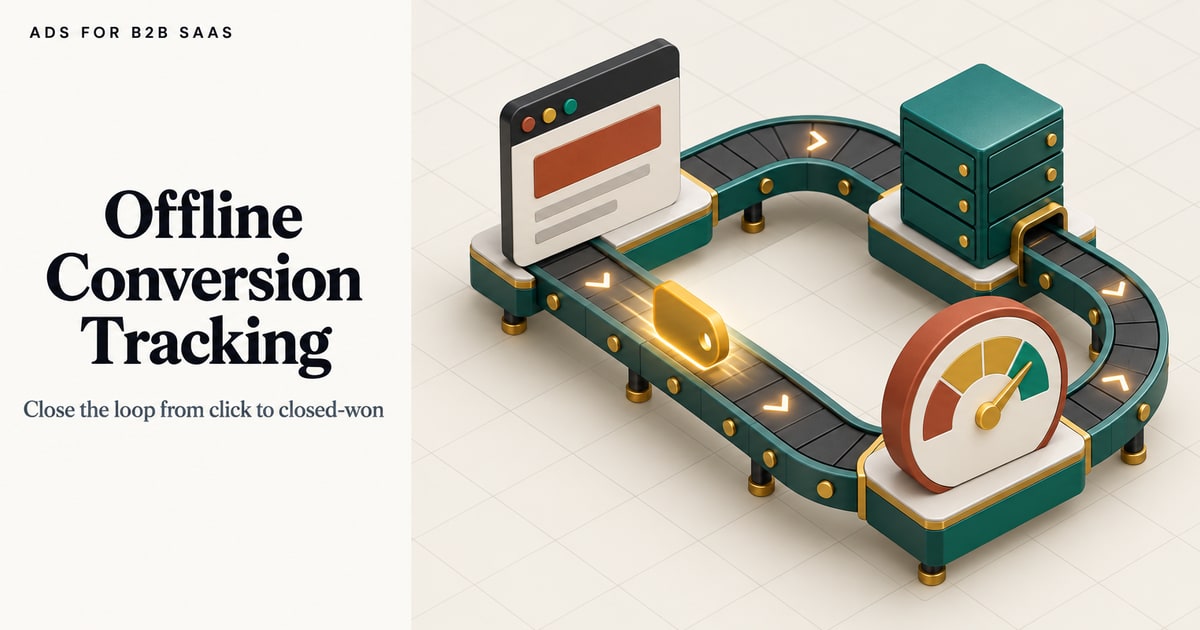
Offline conversion tracking sends CRM pipeline back to ad platforms. Learn how the GCLID loop closes, what to set up first, and why 7-day attribution fails.
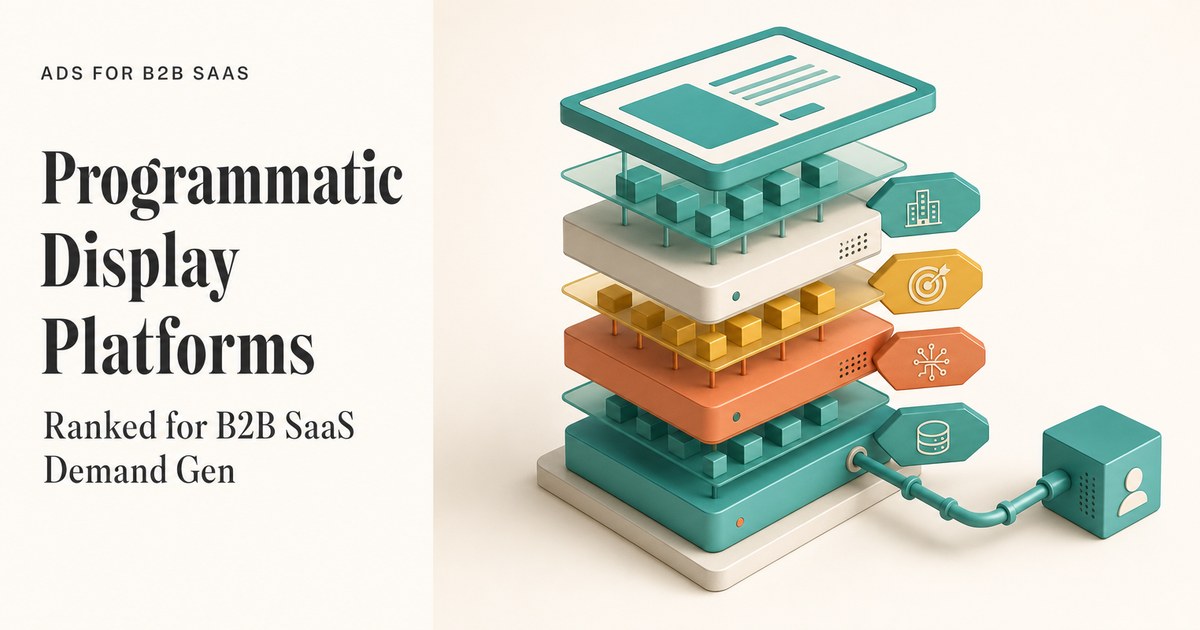
Ranked by ICP targeting depth, minimum viable pilot spend, and CRM conversion passback. Pick the right programmatic platform before committing budget.
Offline conversion tracking sends CRM pipeline back to ad platforms. Learn how the GCLID loop closes, what to set up first, and why 7-day attribution fails.
Learn how to reduce wasted ad spend in B2B SaaS: causes, a waste rate formula, quartile benchmarks and a prioritised fix list that keeps total budget.

Why ad platform conversions and CRM pipeline never match in B2B SaaS: attribution windows, form fills that miss SQL, a GCLID audit and a fix sequence.
Request a quote and our experts will contact you within 24 hours with tailored solutions and pricing.
adsforb2bsaas.com
Last updated: Oct 18, 2026
By Ads for B2B SaaS Editorial Team | Last reviewed: October 13, 2026 This guide is reviewed against the verified research packet before publication and updated when a primary source study is refreshed.
Programmatic display advertising platforms worth testing for B2B SaaS demand gen are 6sense, StackAdapt, The Trade Desk, Demandbase, and DemandScience/Terminus, ranked by ideal customer profile (ICP) targeting depth, minimum viable pilot spend, and the ability to pass offline conversion data back to a CRM. Programmatic now accounts for 91% of all US digital display ad spending (IAB/PwC via MediaPath, 2025), yet most platform comparisons are written for brand advertisers. They say nothing about reaching a buying committee across an 84-day median sales cycle.
This guide ranks each programmatic display advertising platform on three criteria that determine whether a B2B SaaS demand gen program produces pipeline rather than impressions.
Key Takeaways
- Programmatic display advertising platforms split into two categories: B2B-native platforms (6sense, Demandbase) with intent data and account identification built in, and general-purpose platforms (The Trade Desk, StackAdapt) with broader inventory and lower CPMs when you supply intent data separately.
- A fair pilot on a B2B-native programmatic platform requires at least $15,000 to $20,000 in media spend over 60 to 90 days to reach target accounts at meaningful frequency.
- Optimising on form fills instead of sales-qualified lead (SQL) events produces severely inflated cost per SQL. Routing CRM stage progressions back to the platform is the single most important setup step.
- Private marketplace (PMP) and programmatic guaranteed deals reduce ad fraud exposure significantly compared to open auction, where programmatic waste reached $26.8 billion as of Q2 2025 (ANA, 2025).
- Programmatic display is a demand-gen complement to search and social, not a standalone acquisition channel.
The programmatic display advertising platforms worth testing for B2B SaaS demand gen are 6sense, StackAdapt, The Trade Desk, Demandbase, and DemandScience/Terminus, ranked by ideal customer profile (ICP) targeting depth, minimum viable pilot spend, and ability to pass offline conversion data to a CRM. In 2026, 90% of B2B display budgets flow through programmatic platforms, driven by precision targeting using firmographic, technographic, and intent data (Improvado, 2026). Most published comparisons skip the measurement setup that long B2B sales cycles demand.

The five platforms cover the decision space from Series A through growth stage. The right choice depends on your annual contract value (ACV), your existing tech stack, and whether you have a validated target account list. A side-by-side comparison of all five by ICP targeting depth, intent data, CRM passback, and minimum spend appears in the platform comparison table below.
Programmatic display advertising matters for B2B SaaS because buying committees average 6 to 10 people (GrowthSpree, G26, June 2026), and the average B2B purchase now involves 13 stakeholders across multiple departments (Forrester, The State of Business Buying 2024, via TractionComplete, 2024). Search captures one in-market individual at query time. Programmatic display reaches every committee member at target accounts, including the economic buyer who will never click a Google ad.

"Buyers now only spend 17% of their total purchasing time meeting with potential vendors," per Gartner's 2025 buyer behavior study (cited by TractionComplete, 2025). The rest happens in internal reviews and peer conversations where vendors have no direct access. Programmatic display is how B2B SaaS teams stay visible during that phase, through brand recognition and category awareness that committee members encounter before a shortlist is formed.
Most platform comparisons use "B2B" as the audience descriptor and stop there. For a cybersecurity SaaS targeting CISOs at mid-market financial services companies, "B2B" is not a targeting parameter. ICP targeting depth means four layers:
The platforms below are scored on all four layers.
Each programmatic display advertising platform in this guide was scored on three criteria specific to B2B SaaS demand gen: ICP targeting depth (firmographic filters, intent data integration, persona-level exclusions), minimum viable spend for a 60-to-90-day pilot that produces a statistically meaningful signal, and conversion passback capability - the ability to send CRM stage events such as sales-qualified lead (SQL) and closed-won back to the demand-side platform (DSP) as optimisation signals.
Platforms without CRM passback score lower. Feeding a DSP top-of-funnel form fills trains it toward non-converting events.
Sourced benchmark data (GrowthSpree, G26, June 2026-104 B2B SaaS accounts, $78.0M in spend audited): 78% of form fills across audited accounts never reached SQL status. Separately, 91% of audited accounts had no Google click ID (GCLID)-to-CRM connection, and 89% ran default attribution before audit. The same attribution blind spot transfers directly to programmatic: without CRM passback, the DSP optimises toward whatever conversion event it can see - usually a form fill that will never become pipeline.
6sense is a B2B-native demand-side platform (DSP) that identifies anonymous buying intent at the account level and serves display ads to buying committee members before they self-identify. Its DSP added persona-based targeting exclusions in 2026. Minimum viable pilot spend is approximately $15,000 to $20,000 in media over 60 to 90 days. CRM passback to Salesforce and HubSpot is native.

Companies integrating programmatic with account-based marketing (ABM) report 60% higher win rates and 75% better early buyer engagement versus traditional display (Improvado, 2026). That improvement depends on closing the measurement loop: 6sense's native CRM passback means SQL and closed-won events flow back to the bidding model without a custom integration.
6sense is the strongest choice for B2B SaaS teams that:
Sub-vertical fit: Strong for Cybersecurity (CISO and VP Security targeting with layered intent), FinTech (regulatory compliance persona filters), and HR Tech (CHRO buying committee identification). The GrowthSpree SaaS Google Ads Benchmarks 2026 report puts the median cost per SQL for Cybersecurity at $3,500 (B26, April 2026), where committee-level targeting justifies the premium over search.
StackAdapt is a general-purpose demand-side platform with B2B targeting options including firmographic data layers from third-party providers, contextual targeting, and LinkedIn-matched audience segments. Lower minimum spend thresholds make it practical for Series A and Series B B2B SaaS teams running a first programmatic pilot. Intent data is not native: a Bombora or equivalent subscription is required. CRM passback needs a custom build or middleware.
StackAdapt works well for B2B SaaS teams that:
Sub-vertical fit: Well-suited to DevTools (contextual targeting on developer publications and documentation sites) and MarTech/Sales Tech (LinkedIn-matched audience segments for practitioners). GrowthSpree's benchmarks put the median cost per SQL for DevTools at $650 (B26, April 2026). At StackAdapt's price point, contextual targeting on the right publisher network can produce efficient results in that vertical.
The Trade Desk is a general-purpose demand-side platform with the broadest programmatic inventory. Unified ID 2.0 (UID2), its primary post-cookie identity framework, now supports 200-plus data integrations for cookieless B2B targeting at scale (Improvado, 2026). It requires a separate intent data subscription and a custom CRM passback build. It suits B2B SaaS teams already spending more than $30,000 per month in programmatic.
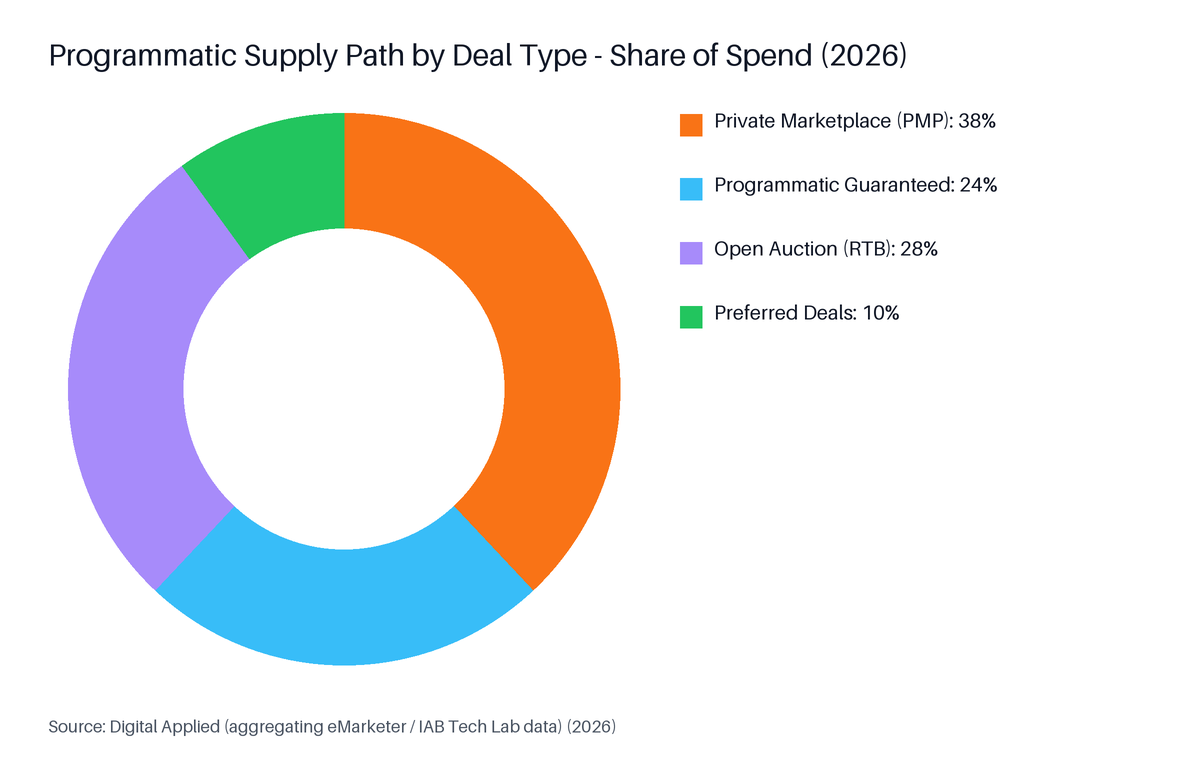
Source: Digital Applied (aggregating eMarketer / IAB Tech Lab data), 2026
The chart above shows how programmatic spend breaks down across deal types in 2026. In full: private marketplace (PMP) accounts for 38%, open auction (RTB) for 28%, programmatic guaranteed for 24%, and preferred deals for 10% (Digital Applied, citing eMarketer/IAB Tech Lab data, 2026). PMP deals and programmatic guaranteed together account for 62% of spend among sophisticated B2B advertisers. The Trade Desk gives teams direct access to curated private marketplace (PMP) deals - a deal type where publishers offer inventory to a select group of advertisers at agreed CPMs - with premium B2B publisher networks. That is its strongest use case for demand gen.
The Trade Desk is the right choice for B2B SaaS teams that:
Sub-vertical fit: Strong for ERP/Operations and Horizontal SaaS, where broad industry publisher networks and PMP access outperform the narrower inventory available in B2B-native DSPs. FinTech teams with existing Bombora subscriptions can layer financial services intent data directly.
Meet with an expert - Free consultation. Bring your programmatic channel questions and brainstorm with a paid media expert.
Demandbase is a B2B-native account-based marketing (ABM) platform with a built-in DSP, intent data, and account identification. ABM programs reporting positive ROI within 12 months reached 71% in 2026, up from 54% in prior years (Digital Applied, citing Gartner and Forrester, 2026). Demandbase suits enterprise B2B SaaS teams at Series B or later running a coordinated ABM motion with a named account list.
"81% of B2B marketers say account-based marketing delivers a higher ROI than their other marketing," per the Momentum ITSMA 2024 ABM Benchmark Study (cited by UseCarly, 2024). Demandbase consolidates intent data, display inventory, and CRM sync under one contract. That integration matters most when buying committees are large - the 13-stakeholder average that Forrester documents (TractionComplete, 2024) means coordinating across many roles, and a single platform reduces the data-stitching overhead.
Demandbase is suited to B2B SaaS teams that:
Sub-vertical fit: Strong for AI/ML SaaS and ERP/Operations, where buying committees are large, deal cycles are long, and account-level coordination across sales and marketing delivers measurable impact.
DemandScience/Terminus is a B2B demand generation platform formed by DemandScience's 2024 acquisition of Terminus. It combines display, streaming campaign management, content syndication, email, and web personalization under one account list. CRM sync and offline conversion passback are built in. Minimum spend is lower than Demandbase, making it accessible to Series B teams adding programmatic as a second or third paid channel.
DemandScience/Terminus works well for B2B SaaS teams that:
Sub-vertical fit: Well suited to Project Management and Horizontal SaaS, where content syndication combined with display retargeting of engaged accounts produces buying-committee coverage across a longer sales cycle.
6sense and Demandbase score highest for B2B SaaS demand gen on ICP targeting depth and CRM passback integration. StackAdapt scores highest on entry cost for a first programmatic pilot. The Trade Desk leads on raw inventory breadth when intent data is already in the stack. The table below ranks all five programmatic display advertising platforms across five B2B SaaS-specific criteria.

| Platform | ICP Targeting Depth | Intent Data | CRM Passback | Min. Pilot Spend | Best For |
|---|---|---|---|---|---|
| 6sense | Very high: firmographic, intent, persona exclusions | Native | Native (Salesforce, HubSpot) | ~$15,000 - $20,000 / 90 days | Account-level intent; ABM |
| StackAdapt | High: firmographic, contextual, LinkedIn-matched | Third-party (e.g. Bombora) | Custom build required | ~$8,000 - $12,000 / 90 days | Series A/B first pilot |
| The Trade Desk | High with added data: UID2, PMP access | Bring your own | Custom build required | ~$30,000+ / month | Scale; PMP access; lowest CPM |
| Demandbase | Very high: full ABM suite, intent, account ID | Native | Native | ~$100,000+ / year contract | Enterprise ABM programs |
| DemandScience/Terminus | High: multi-channel, account lists, CRM sync | Native (display + syndication) | Native | Mid-market contract | Multi-channel demand gen |
For B2B SaaS demand gen, private marketplace (PMP) deals and programmatic guaranteed placements are the recommended deal types over open auction. Programmatic ad waste reached $26.8 billion as of Q2 2025, up 34% in two years, per the ANA Programmatic Transparency Benchmark Report (Measured, 2025). Open exchange invalid traffic (IVT) runs around 20%, which is costly when your total addressable audience is a few thousand accounts.

Programmatic deal type comparison for B2B SaaS:
| Deal Type | Fraud Risk | CPM Predictability | Inventory Quality | B2B SaaS Suitability |
|---|---|---|---|---|
| Open Auction (RTB) | High (~20% IVT) | Low (real-time bidding) | Variable | Low: too much waste for small audiences |
| Private Marketplace (PMP) | Low (vetted publishers) | Medium (floor CPMs) | High | High: recommended starting point |
| Programmatic Guaranteed | Very low | High (fixed CPM) | Very high | High: use for anchor placements on B2B intent sites |
| Preferred Deals | Low | Medium | High | Medium: useful for specific publisher relationships |
For most B2B SaaS teams, starting with PMP deals on intent-rich B2B publisher networks (TechTarget, G2, IDG) and layering programmatic guaranteed placements on high-value properties gives the best combination of reach, fraud protection, and budget predictability.
Passing offline conversion data from a CRM to a programmatic display advertising platform requires three concrete steps. Skipping any one of them forces the DSP to optimise toward top-of-funnel form fills rather than pipeline-stage events. That is the same measurement failure that inflates cost per SQL across search channels.
Sourced benchmark data (GrowthSpree, G26, June 2026-104 B2B SaaS accounts, $78.0M in spend audited): Performance Max (PMax) campaigns running without offline conversions produced a cost per SQL of $2,140. The same accounts, after connecting offline conversions, achieved $620 per SQL - a reduction of more than 70%. The identical logic applies to programmatic DSPs: feed the bidding model form fills and it finds more non-converting form fills. Feed it SQL and closed-won events and it finds more accounts that convert to pipeline.
Capture the platform identifier at form fill. At the moment a prospect submits a form, capture the DSP's click ID or impression cookie alongside standard form fields. Write that identifier into the CRM contact or lead record. Most B2B-native DSPs provide a JavaScript tag or UTM parameter for this purpose.
Map CRM stage progressions to exportable events. Define which CRM stage changes count as conversion signals: typically SQL creation and closed-won opportunity. Set up an automated export or webhook that fires when a contact reaches those stages.
Upload or sync events to the DSP on a schedule. For B2B-native platforms with native CRM connectors, this is an automated sync. For general-purpose DSPs, this is a scheduled CSV upload or an API call. Aim for a lag of no more than 48 hours so the bidding model receives timely signals.
As Fenyx Digital's editorial team states: "Passing sales-qualified opportunity events or CRM stage progressions back to the DSP produces a significantly better optimisation signal than top-of-funnel form submissions" (Fenyx Digital, 2026).
B2C advertisers, direct-to-consumer brands, and ecommerce teams are outside the scope of this programmatic display advertising platform guide. Audience sizes, attribution windows, and creative requirements differ fundamentally from B2B SaaS. This guide is also not suited to B2B SaaS teams with a total ad budget below $5,000 per month. At that spend level, Google Ads or LinkedIn Ads with proper offline conversion tracking will generate a clearer pipeline signal faster and with less operational overhead.
Teams that have not yet established ICP clarity, a working CRM, or a target account list should complete those foundations first. A programmatic display campaign without a defined account list reverts to broad audience targeting. That functions more like brand advertising than demand gen. It will not produce a cost per SQL comparable to search at B2B SaaS budgets.
A fair 60-to-90-day pilot on a B2B-native programmatic display advertising platform such as 6sense or StackAdapt requires at least $15,000 to $20,000 in media spend to generate enough account-level impressions for a meaningful signal. Open auction campaigns can start lower but carry higher invalid traffic risk. Budget should be sized to reach the full buying committee across your target account list at a frequency of three to five impressions per role per week.
Capture the platform's click identifier or account cookie in your CRM at the moment of form fill. When an account advances to sales-qualified lead or closed-won stage, export that CRM event and upload it to the demand-side platform as an offline conversion. As Fenyx Digital notes, "Passing sales-qualified opportunity events or CRM stage progressions back to the DSP produces a significantly better optimisation signal than top-of-funnel form submissions" (Fenyx Digital, 2026).
A B2B-native demand-side platform such as 6sense, Demandbase, or DemandScience/Terminus bundles intent data, account identification, and CRM sync into one product. A general-purpose DSP such as The Trade Desk gives broader inventory access and lower CPMs but requires bringing your own intent data and building the CRM integration separately. For teams early in programmatic testing, B2B-native platforms reduce setup complexity; for teams with scale and existing data, general-purpose DSPs offer more control.
For B2B SaaS demand gen, private marketplace deals and programmatic guaranteed are strongly preferred over open auction. Programmatic ad waste reached $26.8 billion as of Q2 2025 (ANA Programmatic Transparency Benchmark, via Measured, 2025), and open exchange invalid traffic rates run around 20%. PMP deals with vetted B2B publishers and programmatic guaranteed placements on intent-rich sites reduce fraud risk and keep CPMs predictable, which matters when your audience is small.
Upload your target account list and map the six to ten roles in a typical buying committee for your ideal customer profile (ICP): economic buyer, technical reviewer, champion, and end users. Use a B2B-native DSP with account-level frequency capping so each role receives three to five impressions per week rather than concentrating all impressions on one persona. Exclude non-ICP job functions at the account level to avoid wasting budget on employees outside the decision process.
For B2B SaaS demand gen, the ranked order is: 6sense for account-level intent targeting and ABM, StackAdapt for mid-market first pilots, The Trade Desk for scale with existing intent data, Demandbase for enterprise ABM programs, and DemandScience/Terminus for multi-channel demand gen from one account list.
Three decisions determine whether programmatic produces pipeline rather than impressions. First, choose PMP or programmatic guaranteed over open auction. Second, set account-level frequency caps to cover the full buying committee across all six to ten roles. Third, route CRM stage progressions back to the DSP as optimisation signals. Without that last step, the bidding model optimises toward form fills-78% of which never reach SQL status across audited B2B SaaS accounts (GrowthSpree, G26, June 2026).
Programmatic display works best alongside search and social. Teams that have not closed the attribution loop on their primary channels will find the same measurement gap here.
Meet with an expert - Free consultation. Bring your programmatic and channel questions and brainstorm with a paid media expert.
Sources: IAB/PwC via MediaPath (2025); Improvado (2026); ANA via Measured (2025); Forrester via TractionComplete (2024, 2025); Digital Applied (2026); Fenyx Digital (2026); Momentum ITSMA via UseCarly (2024); GrowthSpree, The 2026 B2B SaaS Google Ads Waste Report (G26, June 2026, 104 accounts, $78.0M spend); GrowthSpree, SaaS Google Ads Benchmarks 2026 (B26, April 2026).
© 2026 adsforb2bsaas.com All rights reserved.