Request a quote and our experts will contact you within 24 hours with tailored solutions and pricing.
How to Reduce Wasted Ad Spend in B2B SaaS Google Ads
By Ads for B2B SaaS Editorial Team. Reviewed by a human editor, role: paid media editor. Last reviewed and updated October 28, 2026. Methodology: every figure names its study, sample and date, and vendor or convenience-sample data is labelled as such.
Reducing wasted ad spend in B2B SaaS means measuring spend against sales-qualified leads (SQLs) instead of form fills, then cutting or reallocating money that never produces a qualified outcome, starting with match types, negative keywords and conversion tracking. A sales-qualified lead (SQL) is a lead that sales has accepted as a real sales opportunity.
Spend rises, the demo count stays flat, and the dashboard still shows healthy click-through rates. That gap is where waste hides. This guide shows how to reduce wasted ad spend by naming the causes, calculating a waste rate with a plain formula, and working through a prioritised fix list that keeps total budget intact. The ad account audit checklist goes deeper on the full process.
Key Takeaways
Wasted ad spend in B2B SaaS is spend with no qualified outcome (an SQL or opportunity), not spend with no form fill.
Broad match without negative keywords and Performance Max without offline conversions account for 56% of documented Google Ads waste in one audit of 104 B2B SaaS accounts, a convenience sample and not an industry benchmark (June 2026).
Waste rate is spend with zero qualified outcomes divided by total spend, split by brand, non-brand and campaign type.
Reducing waste does not require cutting total budget: freed spend moves to segments that already produce pipeline, with a tripwire metric as a safeguard.
LinkedIn Ads carried the highest invalid traffic rate of any major platform in Lunio's IT and security study (17.62% in Q1 2026), so channel-level checks matter too.
What causes wasted ad spend in B2B SaaS Google Ads accounts?
Wasted ad spend in B2B SaaS Google Ads accounts is spend that never produces a sales-qualified lead (SQL). Two causes dominate: broad match without negative keywords and Performance Max (PMax) without offline conversions, which together account for 56% of documented waste in The 2026 B2B SaaS Google Ads Waste Report (GrowthSpree, June 2026, 104 accounts, $78.0M spend).
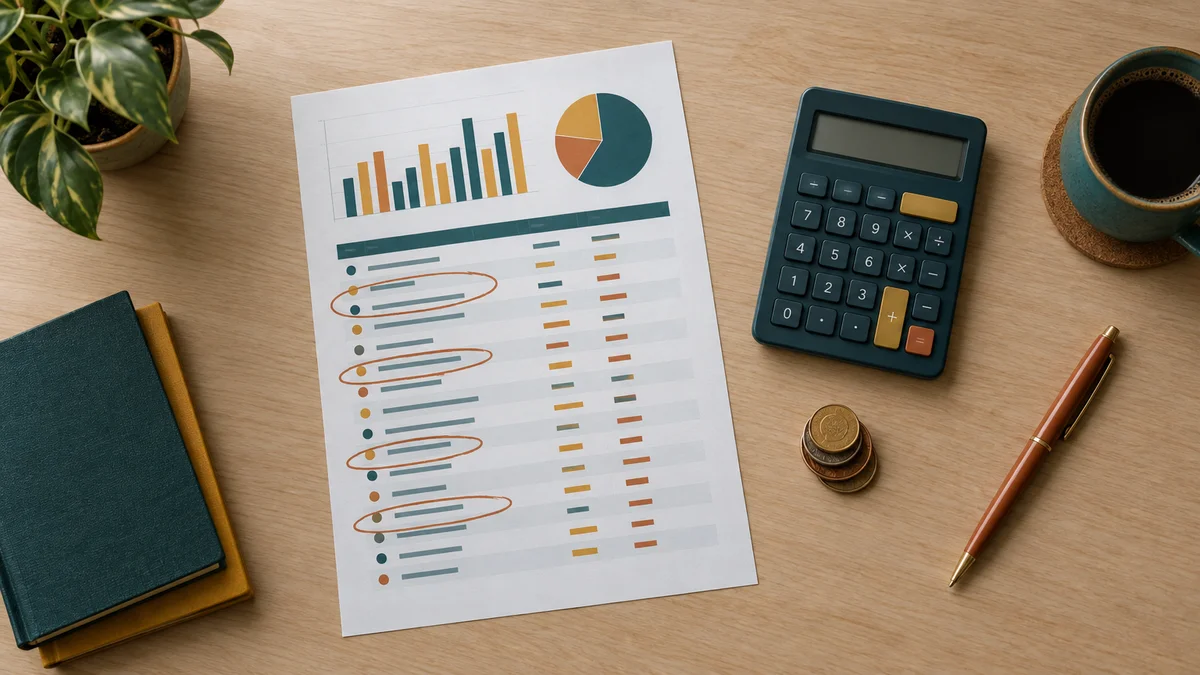
Flat-lay of a printed search terms report with irrelevant terms circled in rust pen beside a calculator
Sourced benchmark data: The 2026 B2B SaaS Google Ads Waste Report (June 2026) audited 104 B2B SaaS accounts and $78.0M in spend. Average waste rate was 34.0%, about $255K per account per year. The best quartile wasted 13.2% and the worst quartile 49.8%. It is a convenience sample of audited accounts, not an industry-wide benchmark.
The table lists the most common causes, how each one creates waste, and the evidence behind it.
Cause
How it creates waste
Evidence
Broad match without negatives
Ads match irrelevant or non-ICP queries
Part of the 56% of waste (2026 Waste Report, June 2026)
Performance Max without offline conversions
Bidding optimises toward form fills
$2,140 cost per SQL blind vs $620 connected (2026 Waste Report)
No CRM connection
Platforms cannot see which clicks became SQLs
91% of audited accounts had no GCLID-to-CRM link (2026 Waste Report)
Broad match is a Google Ads keyword setting that lets ads show for searches related to a keyword, not only close variants of it. Frederick Vallaeys of Optmyzr wrote that "Broad match, by contrast, loses its footing more noticeably in lead gen than in e-commerce." (Optmyzr, 2026). B2B SaaS is a lead-gen model with small audiences, so loose matching hurts quickly.
AI Max is a Google Ads search feature that expands keyword matching using automation. As Adalysis puts it, "AI Max treats all your keywords as broad match, even if you only have exact and phrase match versions of your keywords." (Adalysis, 2026). Google auto-upgraded Search campaigns with campaign-level broad match to AI Max during September 2026, so accounts that never chose this behaviour may now have it.
Performance Max and the CRM gap
Performance Max (PMax) is a Google Ads campaign type that uses automation to serve ads across Google's channels. It optimises toward the conversion it is given. When that conversion is a form fill, it finds more form fills, whether or not sales wants them. In the same audit, 78% of form fills never reached SQL status. Separately, Pivotal found $7.5M in annual spend at one client going to campaigns that generated signups but zero qualified pipeline (Pivotal Consulting Group, 2026). That is a single agency case, not a benchmark.
Invalid traffic
Invalid traffic is a click or impression that has no chance of becoming a customer, such as bots or accidental clicks. Advanced Television, reporting Lunio's 2026 Global Invalid Traffic Report, said 8.51% of paid clicks were invalid across Google, Meta, TikTok, LinkedIn and Bing (Advanced Television, 2026). Fraud Blocker reported an average invalid click rate of 11.4% for Google Ads accounts (Fraud Blocker, 2026). Both vendors sell detection, so treat the gap as a range. Lead-gen campaigns, the B2B SaaS model, also see invalid traffic rates 32.07% higher than ecommerce campaigns (Lunio, 2026).
How do you calculate and find wasted ad spend?
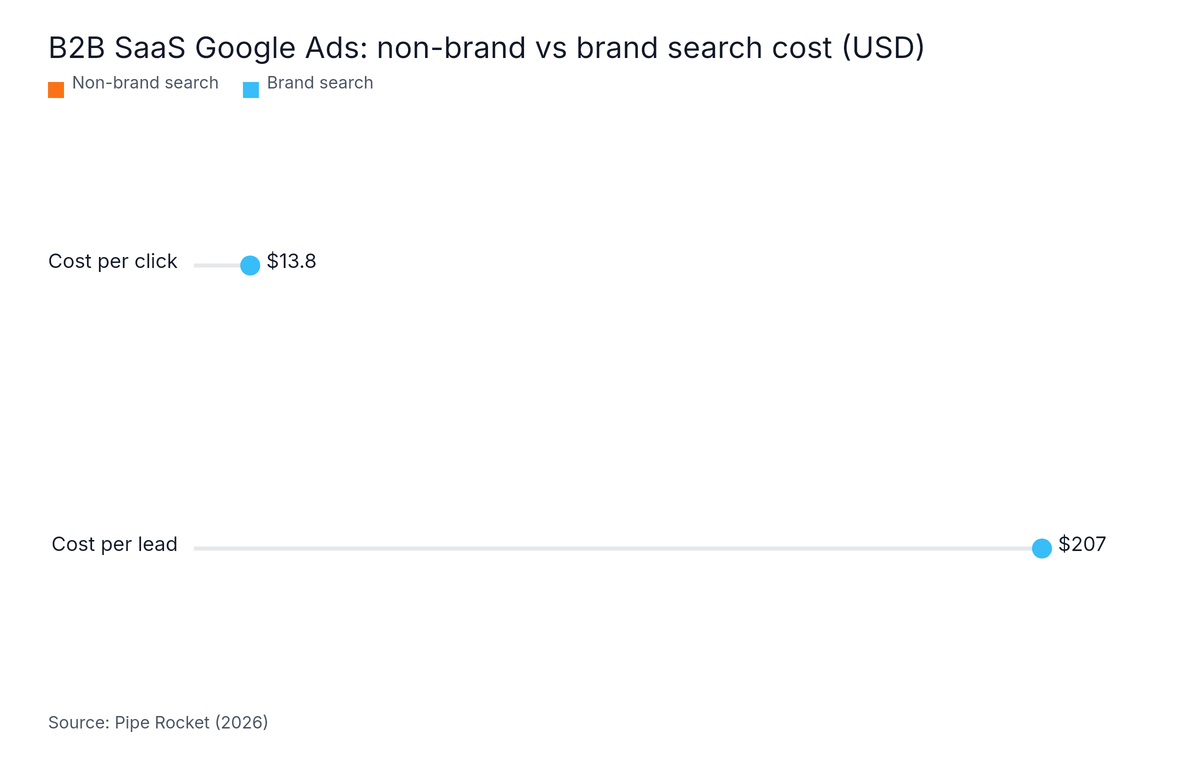
Waste rate is the share of ad spend that produced no qualified outcome. The formula is waste rate = spend with zero SQLs or opportunities ÷ total spend × 100, calculated separately for brand, non-brand and each campaign type. In B2B SaaS Google Ads, non-brand search averaged about $207 per lead against $34 for brand (Pipe Rocket, 2026).
Overhead view of a notebook with a handwritten fraction, a ruler and two stacks of coins of different heights
Waste rate is the share of ad spend that produced no qualified outcome such as an SQL or opportunity. Cost per SQL is total ad spend divided by the number of SQLs produced. Measure against SQLs, not form fills, because a term can look efficient on cost per lead and still produce nothing sales wants.
The waste-rate formula by segment
Run the formula once per row, then once for the whole account. The numbers below are hypothetical and illustrative, not data.
Segment
Total spend (A)
Spend with zero SQLs (B)
Waste rate = B ÷ A × 100
Non-brand search
$30,000
$12,000
40%
Performance Max
$10,000
$4,000
40%
Brand search
$10,000
$1,000
10%
Whole account
$50,000
$17,000
34%
Reading the example: the account spends $50,000 over 90 days, and $17,000 of that went to terms, ads and asset groups with zero SQLs, so the waste rate is $17,000 ÷ $50,000 × 100 = 34%. Non-brand search holds $12,000 of the $17,000, which makes it the first place to look. Replace each figure with your own 90-day cost and CRM outcomes.
What does a good waste rate look like?
The audit of 104 B2B SaaS accounts gives a reference range. It is a convenience sample, so use it as a rough yardstick, not a target.
Position
Waste rate
Source
Best quartile
13.2%
The 2026 B2B SaaS Google Ads Waste Report, June 2026
Average
34.0%
The 2026 B2B SaaS Google Ads Waste Report, June 2026
Worst quartile
49.8%
The 2026 B2B SaaS Google Ads Waste Report, June 2026
Average after a 90-day fix
11.0%
The 2026 B2B SaaS Google Ads Waste Report, June 2026
For cost per SQL, the SaaS Google Ads Benchmarks 2026 report put the median at $800 to $2,500 (April 2026), with DevTools at $650 and Cybersecurity at $3,500.
Lollipop chart: B2B SaaS Google Ads: non-brand vs brand search cost (USD). Highest: Cost per lead at $207.
The chart shows the Pipe Rocket gap between non-brand search ($13.75 CPC, $207 per lead) and brand search ($3.12 CPC, $34 per lead). That is why blended reporting understates non-brand waste.
How to find the waste in six steps
Export 90 days of search terms, with cost, by campaign type.
Import SQL and opportunity status from the CRM against each click, using the Google click ID.
Separate brand from non-brand campaigns.
Mark each search term, placement and campaign with spend and zero SQLs.
Add the marked spend and divide by total spend for each segment.
Check invalid traffic reports for a second layer of non-converting spend.
A Google click ID (GCLID) is a unique identifier Google appends to a landing page URL so a click can be matched to a later CRM outcome. The median B2B SaaS sales cycle is 84 days, so give each term enough time to mature before marking it as waste. The wasted ad spend diagnosis guide covers that analysis in more detail.
How do you reduce wasted ad spend in a B2B Google Ads account?
To reduce wasted ad spend in a B2B Google Ads account, fix measurement first, then match types, then reallocate. Connect SQL and closed-won events as offline conversions, add negative keywords and brand controls, and move freed budget into segments with proven pipeline. In the same waste report, a 90-day fix moved average waste from 34.0% to 11.0% and cut cost per SQL by 62%.
Overhead flat-lay of a paper checklist with ticked items, a pen and a small brass key on a pale surface
Step 1: Connect CRM outcomes to Google Ads
Enhanced conversions for leads is Google's upgraded version of offline conversion import. In the words of Google's Accelerate resource, it "is an upgraded version of offline conversion import that uses user-provided data, such as email addresses" (Google Accelerate, 2026). Make an SQL or opportunity event the optimisation target, and name one owner for the feedback loop. The gap is common: 91% of audited accounts had no GCLID-to-CRM connection and 89% ran default attribution. Default 7-day click attribution captured only 5% to 15% of revenue against an 84-day median sales cycle. Verify the setup by checking that SQL conversions appear in Google Ads within days of CRM status changes.
Step 2: Control match types and AI Max
Open the change history and confirm whether campaigns were moved to AI Max in September 2026.
Review the AI Max search term reports. Google's June 2026 documentation update warned that filtering by the AI Max match type understates its traffic, so do not rely on that filter alone (PPC Land, 2026).
Add negative keywords for job seekers, students, free tools and competitors' support queries.
Set brand controls so that AI Max does not take brand queries.
Step 3: Fix Performance Max and separate brand
Run PMax only with SQL-based conversions. Keep brand and non-brand in separate campaigns so that cheap brand results stop hiding non-brand waste.
How can you cut wasted ad spend without cutting total budget?
Move the money instead of removing it. Gartner reported that "Marketing budgets remain effectively flat, rising only slightly to 7.8% of company revenue in 2026 from 7.7% in 2025." (GroundedKit, quoting Gartner, 2026). Also, 56% of CMOs say they lack the budget for their 2026 strategy (Prompt the Market, 2026). Extra budget is unlikely, so reallocation is the practical route. Cut one segment at a time, shift the freed spend into the segment with the lowest cost per SQL, and set a tripwire: if cost per SQL rises past target for two weeks, reverse the last change.
Prioritised checklist
Priority
Fix
Effort
Expected impact and timing
1
Import SQL and closed-won as conversions
Medium
PMax cost per SQL was $2,140 blind vs $620 with offline conversions (2026 Waste Report). Judge after one 84-day sales cycle
2
Separate brand from non-brand
Low
Not measured alone. Part of the 90-day fix (34.0% to 11.0% waste)
3
Add negatives and AI Max brand controls
Low
Not measured alone. Part of the 90-day fix, which cut cost per SQL by 62%
4
Pause zero-SQL segments after a full sales-cycle window
Low
Not measured alone. Wait a full cycle before cutting
5
Reallocate into lowest cost-per-SQL segments
Medium
Re-scoring ads by cost per SQL improved it by about 44% with no extra spend (Paid Ads Pipeline Disconnect, June 2026)
6
Review invalid traffic reports
Medium
Vendor ranges run from 8.51% to 11.4% of clicks, so size the check before acting
Meet with an expert. Free consultation. Bring your ad account questions and brainstorm with a paid media expert. The answer above stands without a call. The paid search guide for B2B SaaS covers how search costs behave.
How does automation and AI bidding reduce wasted ad spend?
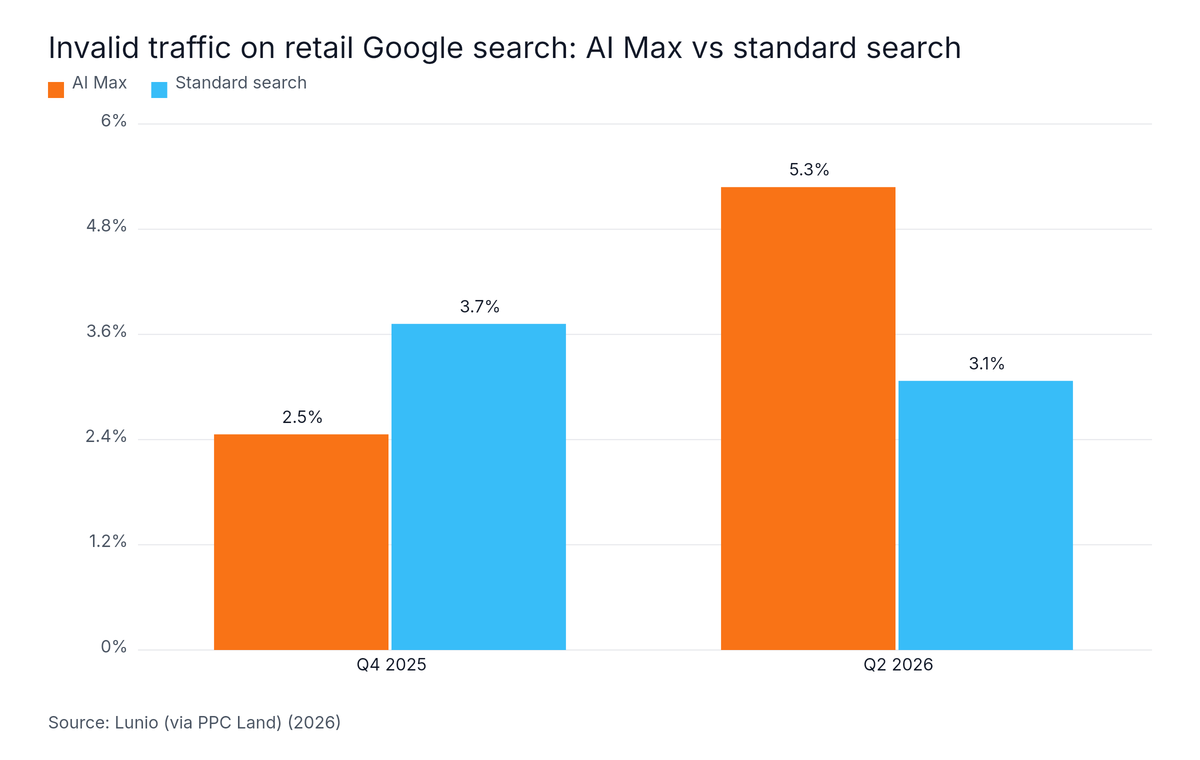
Automation and AI bidding reduce wasted ad spend only when they optimise toward the right conversion event. Smart Bidding, PMax and AI Max spend faster on whatever signal they receive, so SQL or closed-won data steers bids toward qualified buyers. On retail search, AI Max campaigns had 5.28% invalid traffic in Q2 2026 against 3.07% for standard search (PPC Land, 2026).
Still life of an open clockwork mechanism beside a brass compass on a light desk
AI Max invalid traffic on retail search rose from 2.46% in Q4 2025 to 5.28% in Q2 2026 (PPC Land, 2026). This is a correlation, not a proven cause, and retail is not B2B SaaS. Use it only as a warning that broader automated matching can add invalid traffic.
Grouped Bar chart: Invalid traffic on retail Google search: AI Max vs standard search. Highest: Q2 2026 at 5.3%.
The bidding signal matters more than the bidding tool. PMax cost per SQL was $2,140 running blind against $620 with offline conversions.
Sourced benchmark data: The Paid Ads Pipeline Disconnect (June 2026) covered 1,412 ad variants, 96 accounts and $14.2M in spend. Cost per SQL correlated with pipeline at r = 0.71, cost per lead at r = 0.23 and CTR at r = 0.09. In 43% of A/B tests, the higher-CTR winner produced fewer or costlier SQLs. Re-scoring ads by cost per SQL improved cost per SQL by about 44% with no extra spend.
Practical controls for automated campaigns:
Use SQL or opportunity events as the primary conversion, with form fills as a secondary signal.
Review search term reports weekly after any AI Max migration.
Apply brand restrictions where Google offers them. Google began rolling out a branded search control inside AI Max in late May 2026 (PPC Land, 2026).
Keep negatives layered, since AI Mode search term reporting shows an approximation of intent and negatives may not block the underlying query.
How do B2B SaaS teams reduce wasted Meta Ads and LinkedIn Ads spend?
B2B SaaS teams reduce wasted Meta Ads and LinkedIn Ads spend by tightening audiences to the ideal customer profile (ICP), filtering invalid traffic, and judging results by SQLs instead of clicks. LinkedIn had the highest invalid traffic rate of any major platform in Lunio's IT and security study, rising to 17.62% in Q1 2026 (PPC Land, 2026).
Flat-lay of a sieve beside a bowl holding gold coins while grey pebbles remain in the sieve
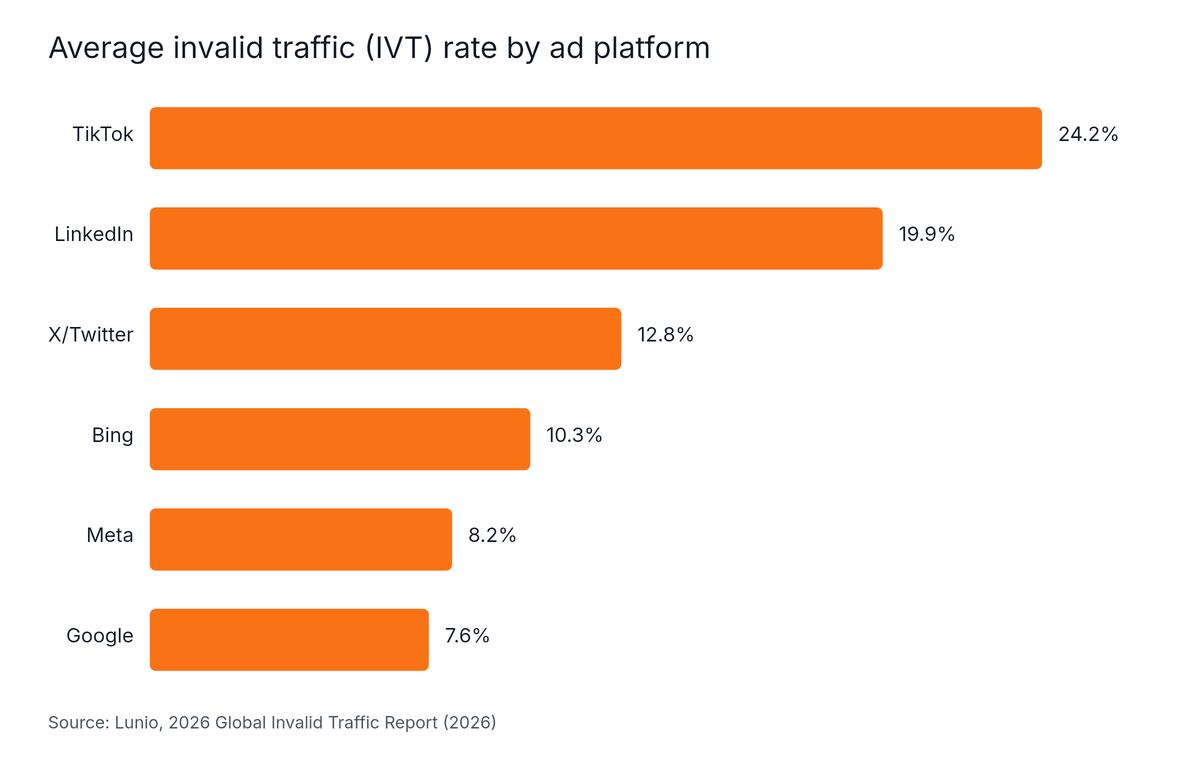
An ideal customer profile (ICP) is the description of the company and buyer most likely to become a long-term customer. In the same Lunio study, LinkedIn's rate rose from 13% in Q3 2025. In a banking and lending sample, LinkedIn averaged 36.08% (PPC Land, 2026). Across platforms, Lunio's 2026 Global Invalid Traffic Report put LinkedIn at 19.88%, Meta at 8.2% and Google at 7.57% (Lunio, 2026). These are vendor studies and the sectors differ, so read them as a direction, not a forecast.
Horizontal Bar chart: Average invalid traffic (IVT) rate by ad platform. Highest: TikTok at 24.2%.
The audit of LinkedIn Ads accounts points to targeting as the main leak.
Sourced benchmark data: Wasted LinkedIn Ads Spend in B2B SaaS (June 2026, 56 accounts, $9.4M spend) found an average waste rate of 32.0%, about $53,600 per account. Job function, seniority and company size targeting accounted for 67% of that waste. Decision-makers received only 33% of budget against a 60%+ target.
Platform
Main waste risk
What to do
LinkedIn Ads
Wrong job function, seniority or company size
Target the buying committee, exclude small companies outside the ICP, measure by cost per SQL
Meta Ads
Low-intent form fills
Use qualifying questions in lead forms, sync form data with the CRM, judge by SQLs
Both
Invalid traffic and poor placements
Apply invalid traffic filtering and review placements monthly
No independent B2B lead quality data for Meta Ads was found for this guide, so the Meta advice rests on the same SQL-first logic as Google. The Google Ads vs LinkedIn Ads verdict compares the two channels by deal size and sales cycle, and the channel and budget allocation guide covers how to split spend.
Who is this guide not for?
Ads for B2B SaaS guidance on how to reduce wasted ad spend suits teams that track leads through a CRM, and does not suit ecommerce stores, accounts with no SQL tracking or very small budgets. Its figures also carry limits: invalid traffic rates come from detection vendors such as Lunio, which reported 8.51% of paid clicks as invalid (Advanced Television, 2026).
Three further limits apply:
Convenience sample. The 34.0% average waste rate comes from 104 audited accounts and $78.0M in spend, so it is a reference range, not an industry-wide benchmark.
Vendor, retail and finance samples. Fraud Blocker put Google Ads invalid clicks at 11.4% (Fraud Blocker, 2026), so use ranges. The AI Max and banking figures come from retail and banking accounts, not B2B SaaS.
Long sales cycles. With an 84-day median sales cycle, and 78% of form fills never reaching SQL status, a term with no SQL after 30 days is not yet proven waste. Give it a full cycle before cutting, and see why return on ad spend (ROAS) alone is the wrong end goal for B2B SaaS.
Frequently Asked Questions
How do I reduce wasted ad spend in B2B marketing?
Reduce wasted ad spend in B2B marketing by judging every campaign on sales-qualified leads and closed-won pipeline instead of clicks or form fills. Connect the CRM to the ad platforms, exclude audiences and search terms outside the ideal customer profile, and move budget from segments with zero qualified outcomes into segments that produce pipeline.
How do you prevent wasted ad spend?
Preventing wasted ad spend means building controls before budget is spent: negative keyword lists, brand and non-brand separation, CRM-based conversion tracking, audience exclusions and a scheduled review of search terms. Set a tripwire metric, such as cost per SQL rising past target, so that a leak triggers a review instead of running unnoticed for a quarter.
How can agencies reduce wasted ad spend?
Agencies reduce wasted ad spend by reporting on SQLs and pipeline instead of clicks, owning the CRM feedback loop, and documenting each change with a before-and-after cost per SQL. Gartner's 2026 survey found 39% of CMOs plan to cut agency and labour spend, so waste reduction needs visible proof (Marketing Helm, 2026).
How do fractional CMOs reduce wasted ad spend?
Fractional CMOs reduce wasted ad spend by setting one shared pipeline metric across marketing and sales, auditing ad accounts against it, and reallocating spend that has no qualified outcomes. With marketing budgets flat at 7.8% of company revenue in 2026 (Marketing Helm, reporting Gartner), they also name an owner for the CRM feedback loop and hold a recurring review.
How do B2B SaaS teams reduce wasted Meta Ads spend?
B2B SaaS teams reduce wasted Meta Ads spend by qualifying leads with form questions, syncing lead data to the CRM, and judging campaigns on SQLs, not form fills. Lunio's 2026 report put Meta's average invalid traffic rate at 8.2%, against 19.88% for LinkedIn (Lunio, 2026). It is vendor data, so treat it as a guide.
Conclusion
Wasted ad spend in B2B SaaS is spend that never produces a qualified outcome, and the fix starts with measuring that honestly. The main points:
Define waste against SQLs and opportunities, not form fills.
Calculate waste rate by segment (brand, non-brand and campaign type) and compare it with the 13.2% to 49.8% quartile range.
Connect CRM outcomes through enhanced conversions for leads before tuning anything else.
Add negatives and brand controls to broad match, AI Max and PMax, then reallocate freed spend instead of cutting budget.
Check LinkedIn Ads and Meta Ads for invalid traffic and ICP drift.
The next step is to export 90 days of search terms, mark the spend with zero SQLs, and work the prioritised checklist from the top. The ad account audit process turns that into a full review.
Written by
Ishan Manchanda
Ishan Manchanda is co-founder of GrowthSpree, a B2B SaaS marketing consultancy founded in 2017 that has managed $60M+ in ad spend across 300+ B2B SaaS companies. He focuses on demand generation, go-to-market strategy and pipeline growth, and has been featured in Silicon Valley Times, SaaS Mag and the Unbounce podcast.
 Ishan ManchandaNov 5, 2026